
How Does a Rebar Cage Welding Machine Work?
A rebar cage welding machine turns loose steel bars into a rigid, dimensionally consistent reinforcement cage by winding a continuous hoop around a group of longitudinal bars and welding every intersection in one automated pass. Understanding that sequence matters to any contractor weighing manual cage tying against mechanized production: the same cage can take a crew hours to assemble by hand, yet be welded in a fraction of that time on a machine, with far less variation in spacing and weld strength. This article explains the working principle, the controls that decide cage quality, where these cages are used, and how to match a configuration to a real project — so buyers can judge whether an automatic system fits their bar diameters, cage lengths and output targets before placing an order.
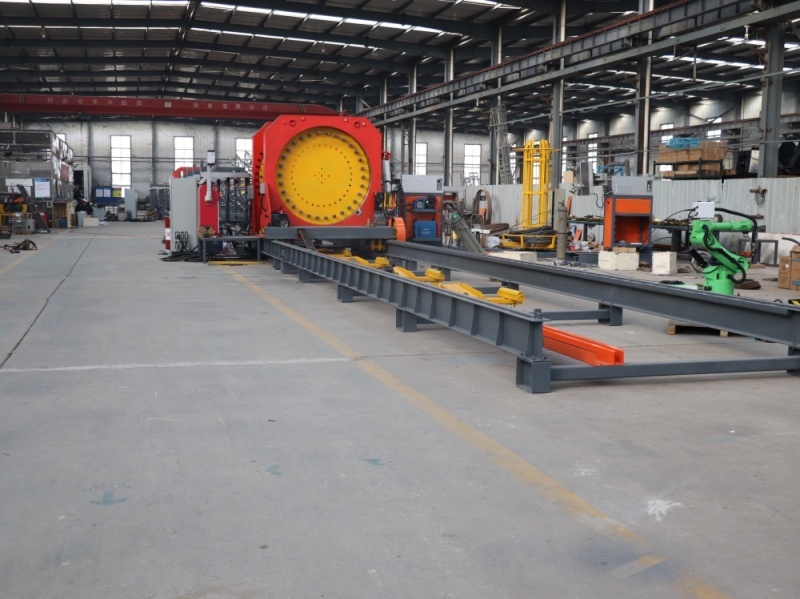
Why the Reinforcement Cage Matters
Reinforcement cages are the internal skeleton of bored cast-in-place piles, and they also appear in bridge piers, retaining structures, high-speed rail foundations and metro stations. Once a cage is lowered into a borehole and concreted, it cannot be inspected or corrected, so bar spacing, hoop pitch and weld integrity have to be right before it leaves the yard. Traditionally, cages were tied by hand with wire on frames — a labor-intensive process whose quality depended heavily on crew skill and fatigue. As projects grow in scale and schedules tighten, fabricators turn to mechanized welding to make cage production predictable rather than dependent on headcount: consistent cages, shorter cycle times and safer handling of heavy assemblies.
How a Rebar Cage Welding Machine Works
The process begins at the longitudinal bar rack. Straightened main bars are fed through a series of guide tubes or a positioning frame that fixes their number and angular spacing around the cage circumference. This determines how many longitudinal bars the finished cage will contain and how evenly they are distributed — two parameters that directly affect the cage's load-bearing behavior.
Next, the cage is set in rotation. Motor-driven rollers or a rotating mandrel turn the assembly while a steel hoop, unwound from a pay-off coil and passed through a straightening unit, is fed into the path of the rotating bars. Because the hoop is advanced axially at a controlled rate as the cage turns, it wraps around the longitudinal bars in a regular helix. The distance advanced per revolution becomes the hoop pitch. A programmable controller, usually with servo-driven travel, holds that pitch steady from the first turn to the last — the single most visible difference between a machine-made cage and a hand-tied one.
Welding happens at a fixed station. As each hoop crosses a longitudinal bar, a welding gun applies a short, controlled arc — most commonly CO2 gas-shielded welding — fusing the intersection instead of tying it with wire. Weld current, arc voltage and wire feed speed are set according to bar diameter so the joint is strong without burning through thinner sections. Depending on the model, one or more guns work in sequence while the cage continues to rotate and advance. At the discharge end, the completed cage rolls onto support rollers or a conveyor, ready for lifting, stacking or transport to the casting site.
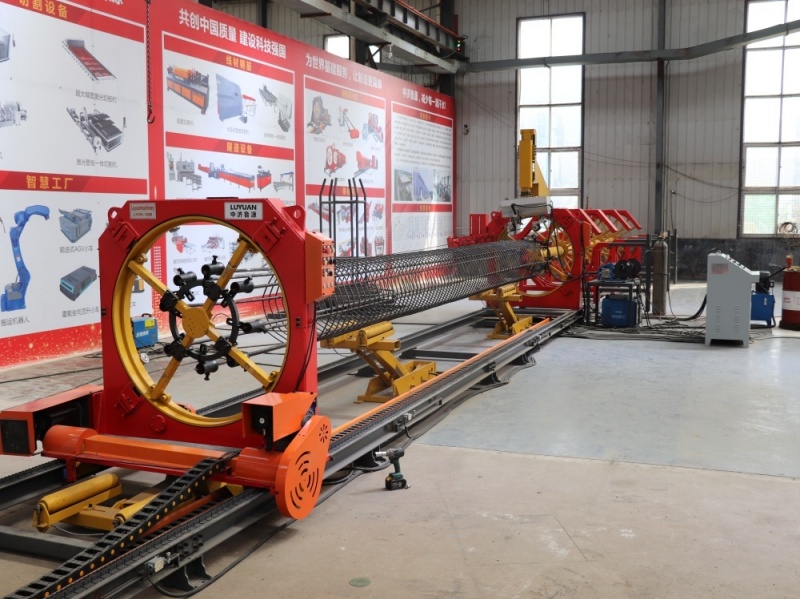
What the Controls Actually Change
From the operator's panel, several variables define the output. Cage diameter is set through the forming and support geometry; hoop pitch is set by travel per revolution; the number of longitudinal bars is fixed by the guide arrangement; and rotation speed plus welding parameters govern cycle time and joint quality. Modern units store these settings as recipes, so switching between recurring cage types takes minutes rather than a full re-setup. It is worth noting that even a well-built machine cannot compensate for rusty or bent bar, inconsistent coil material or incorrect gas and wire settings — good input material and a disciplined setup remain part of the process.
Where These Cages Are Used
In pile foundation work, the cage is lowered into the borehole before concreting and must stay centered and intact during placement. Bridge construction uses larger-diameter, heavily reinforced cages for piers and foundations, where weld consistency under cyclic loads is critical. High-speed rail and metro projects demand high volumes of cages to tight schedules, making repeatable output especially valuable. Rebar fabrication plants serving several sites benefit most: one machine can produce cages to different specifications in batches. In each case, the value of an automatic rebar cage welding machine lies in repeatability and throughput, not simply in replacing labor.
Introducing the Equipment
For fabricators and contractors facing these demands, Luyuan Machinery supplies an automatic rebar cage welding machine designed for continuous, controlled cage production. It is suited to rebar yards, precast operations and foundation contractors who need stable hoop spacing and repeatable weld quality across batches. The machine integrates bar positioning, controlled rotation, synchronized hoop feeding and multi-point welding under a centralized control system, with adjustable cage diameter and pitch so operators can handle different project specifications on the same line. Rather than pushing a single universal model, the practical question is configuration: the working range for bar diameter, the maximum cage diameter and length, the number of welding stations and the level of automation should be matched to the actual cage drawings and daily output required. Buyers who can share those details with the manufacturer get a far more accurate recommendation than one based on horsepower or price alone.
Frequently Asked Questions
1. What is a rebar cage welding machine used for?
It fabricates cylindrical reinforcement cages by winding hoop steel around longitudinal bars and welding the intersections, mainly for bored piles, bridge foundations and other elements needing a prefabricated steel skeleton.
2. How does machine welding compare with manual cage tying?
Manual tying relies on wire and crew skill, so pitch and joint quality can vary along the cage and between shifts. A welding machine holds those parameters consistent and produces cages at a steadier rate, especially on long runs.
3. What determines which configuration I need?
The deciding factors are your bar diameter range, cage diameter and length, number of longitudinal bars, required daily output and available handling equipment. These should be checked against the technical parameters of each model rather than assumed.
4. Can one machine produce different cage sizes?
Yes, within the machine's working range. Diameter and hoop pitch are adjustable through the control system and setup, so fabricators serving multiple projects can run different cage specifications in separate batches.
5. What affects the service life of the equipment?
Regular cleaning of spatter, correct wire and gas settings, timely replacement of wear parts at the welding and feeding stations, and clean, straight reinforcement all extend operating life. A clear maintenance schedule is as important as the machine itself.
Summary and Next Steps
A rebar cage welding machine positions longitudinal bars, rotates the assembly, feeds a hoop in a controlled helix and welds each crossing under set parameters. The result is a cage with consistent geometry and reliable joints, produced at a rate manual tying struggles to match. If you are evaluating mechanized cage production for pile, bridge or rail work, contact Luyuan Machinery for detailed specifications, technical documentation and a configuration review based on your cage drawings and output targets — and a quotation matched to your project.


