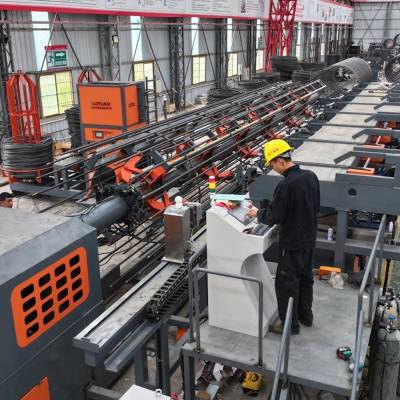
How Automation Is Changing Pile Cage Production
Pile cage production has moved from a site activity to a factory process, and the pressure is not coming from machine catalogues. It is coming from what piling contractors are now asked to guarantee: cage tolerance at the bore, weld integrity after lifting, and delivery to programme. On a bored pile package, a cage that is oval, out of pitch or short of welds does not fail quietly. It stops the rig.
That is why automated pile cage production has become a live procurement question. Buyers want to know what the equipment controls, where manual steps remain, what output is realistic, and how to phase investment so one automated station does not just move the bottleneck downstream.
Why manual cage fabrication is running out of room
The conventional method is simple: main bars are laid into a jig, the spiral is paid off from a turntable, and welders or tying crews fix each intersection. On small or irregular orders it remains competitive. The problem is that every step depends on operator judgement, and judgement does not scale.
Three pressures expose the limit. Cage geometry is getting larger and heavier as pile diameters and depths increase on bridge and rail foundations, and manual rotation of a long cage is slow and a handling risk. Weld quality is inspected rather than assumed, so variation between shifts becomes a commercial risk. And labour availability is the constraint contractors cite most often, because the skill to pitch and weld a cage accurately is not quickly trained.
What automation actually changes on the production floor
An automated line does not remove the craft from cage making. It moves the craft into setup, then repeats that setup precisely for every cage in the batch. Four functions decide whether the machine delivers its rated output.
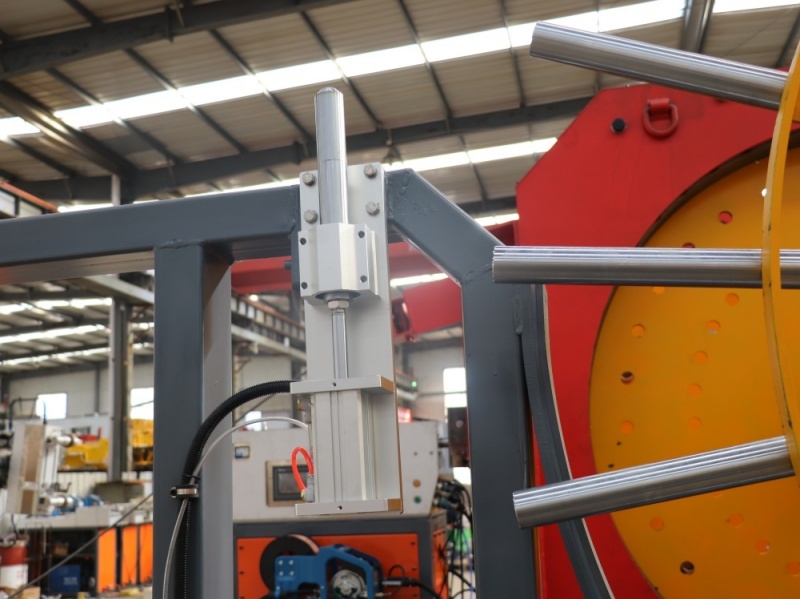
Cage location and clamping. Main bars are indexed against a datum and clamped by discs or rings that hold the cage round while it turns. This step decides finished roundness and bar spacing consistency. A clamping system covering only part of the diameter range forces compromises at the edges of the envelope, so working range matters more than headline maximum.
Rotation and pitch control. Spiral pitch is a drawing dimension, not an operator preference. The cage is rotated by a drive under PLC control while the welding head traverses at a matched rate, so pitch is set numerically. Pitch error accumulates along a cage, and a controlled pitch does not drift across a shift.
Welding parameters. Consistent welds come from consistent current, wire feed, travel speed and shielding, held in a stored programme instead of adjusted per operator. Recipe storage per cage type also shortens changeover, because the machine returns to a known state rather than being re-tuned by trial.
Handling and ejection. Long cages are awkward to move. Automated lines discharge the cage without manual rotation, cutting cycle time and the handling incidents that dominate yard accident reports.
From a single machine to a production line
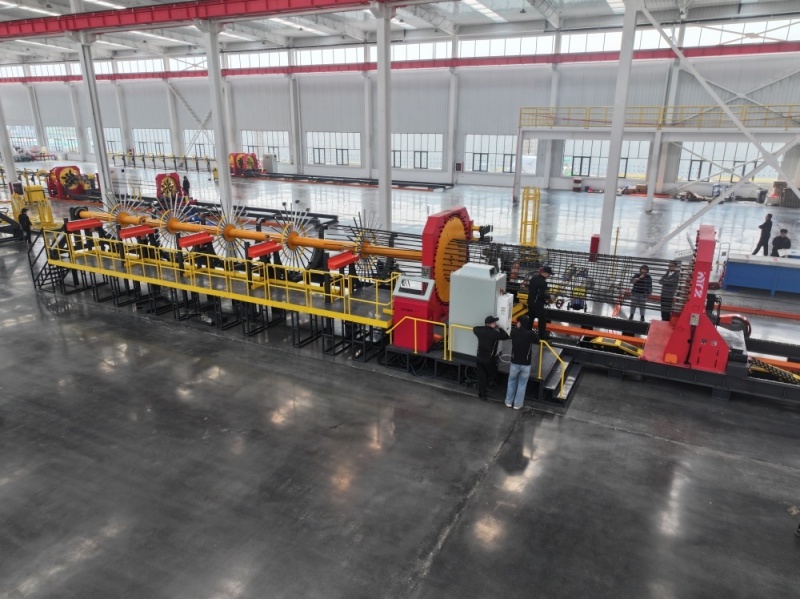
The most common first-time mistake is treating the welder as the whole solution. A cage line is a sequence: bar cutting and feeding, end preparation where specified, assembly and welding, then transfer to storage or the transporter. If cutting is manual, the welder waits. If the yard cannot move finished cages out, the welder waits again.
Automated pile cage production therefore tends to be phased. A yard usually starts with the welding station and the handling that feeds it, measures where the queue forms, then automates the upstream step that is constraining the station. Planning the whole sequence at the outset avoids buying a second machine that duplicates capacity instead of relieving it. Layout deserves equal attention: cage length sets the building length required, and the distance from station to storage rack decides how much of the shift is spent handling rather than welding.
Where the change is visible in the field
Bored pile work. Cast-in-place piles need cages that enter the bore without distortion and hold their cover. Automated welding supplies the roundness and pitch consistency that tremie placement demands, plus the batch repeatability that lets a contractor predict site behaviour.
Bridges and viaducts. Pier and pile cap reinforcement is heavy, often long and densely spiralled. Handling dominates the cycle, which is where an automated line earns its cost.
High-speed rail. Rail packages carry documentation requirements as well as dimensional ones. Stored welding programmes give a fabricator a traceable production record instead of a shift-by-shift account of manual adjustment.
Rebar processing plants. For a fabricator serving several projects, the value is changeover speed: quoting delivery from a known cycle time is easier to schedule than quoting from experience.
Specifying an automated cage line
Specification starts from the drawings, not a model number. Define the diameter and length range across the current order book and the next project, main bar count and diameter, spiral pitch range, and finished cages per shift at realistic availability. Then define the weld standard the inspector will apply.
At that point the equipment conversation becomes concrete. Luyuan builds the automatic rebar cage welding line for this production profile, with PLC-controlled rotation, programmable pitch, stored welding recipes and integrated cage handling. It suits piling contractors setting up a fabrication yard, bridge and rail subcontractors with repeatable cage schedules, and rebar plants supplying multiple sites. Buyers can review the working principle and diameter ranges on the automatic rebar cage welding machine page before requesting a layout drawing.
FAQ
What does automated pile cage production mean in practice?
The cage is positioned, rotated, pitched and welded under programmed control, with the operator setting parameters rather than forming each joint by hand. Feeding and handling vary by configuration.
Does automation remove the need for skilled welders?
It reduces the number of welding decisions per joint, not the need for competent setup, verification and inspection. The skill shifts from forming welds to controlling the process that produces them.
What output can a buyer realistically expect?
Calculate from welding time per joint, joints per cage, loading and unloading time, and realistic availability. Ask for that calculation against your own drawings rather than a bare cages-per-shift claim.
Can an automated line handle more than one cage type?
Yes, where recipes are stored and the clamping range covers the sizes required. Confirm changeover time in writing, since it drives small-batch economics.
What information is needed for a quotation?
Diameter and length range, main bar count and diameter, spiral diameter and pitch, output per shift, floor length and site power supply, so the proposal reflects a real yard.
Conclusion
Automation is changing pile cage production by making the cage a manufactured part rather than a site fabrication. The gains come from controlled geometry, repeatable pitch and documented welding parameters, and they appear only when the handling and feeding steps keep pace with the welding station. Buyers who specify from drawings and plan the full sequence get a line that holds its output; buyers who specify from a price list get a machine that waits.
Send your cage drawings, diameter and length range, and target output per shift to the Luyuan technical team for a configuration proposal, a yard layout suggestion and a project-specific quotation.