
How to Choose Cage Welding Equipment for Infrastructure Projects
Choosing cage welding equipment for an infrastructure project comes down to four engineering questions: which cage diameters and lengths the drawings actually call for, how many finished cages the site or fabrication plant must deliver per shift, which weld quality standard the inspector will apply, and how much of the production cycle should be automated. Answer them correctly and the specification follows; answer them loosely and a well-built welder still becomes the bottleneck on a piling programme.
Why the equipment decision carries more risk than it used to
Reinforcement cages are no longer a secondary item on a bridge, highway or high-speed rail package. On cast-in-place bored pile work, the cage is a structural element that must arrive straight, correctly pitched and with welds that survive lifting and driving. A cage that is out of tolerance at the tremiper stage is expensive to correct and slow to replace.
Procurement teams now compare a welder against manual jig welding on total cost per cage rather than purchase price alone. That comparison depends on measurable inputs: achievable cycle time, scrap rate at the spiral and main bar joints, labor content per cage, and how quickly the line can be switched between cage types.
How automatic cage welding equipment works
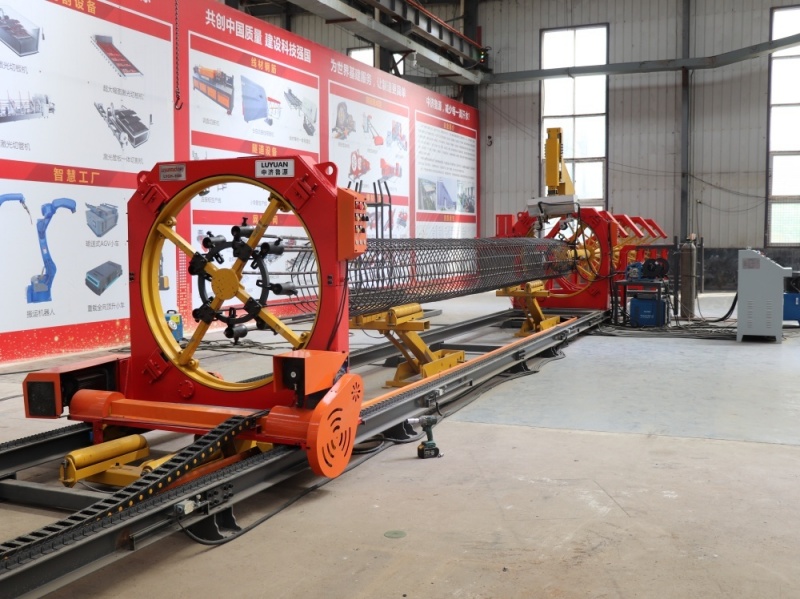
An automatic rebar cage welding machine holds the main bars in position with hydraulically or mechanically adjustable clamping discs, rotates the assembled cage on a driven main shaft, and welds the spiral reinforcing bar to the main bars with one or more welding heads that travel along the cage axis. A PLC coordinates rotation speed, carriage travel and welding current so that the spiral pitch stays constant from end to end.
The practical details are where machines differ. The clamping disc arrangement determines how many main bars can be loaded and how evenly the cage is supported at larger diameters. The welding head design determines whether the machine can run a single wire or twin wire setup, and whether it can weld both the outer spiral and any internal stiffening rings. Bar straightening and feeding units upstream of the welder matter as much as the welder itself: a cage built from poorly straightened bar will fight the clamps and produce inconsistent spiral pitch no matter how good the welding controller is. On the control side, recipe storage is a genuine productivity feature, because it lets an operator recall a cage type by diameter, length, main bar count and pitch instead of resetting the machine by hand.
Fixed gantry versus rotating cage designs
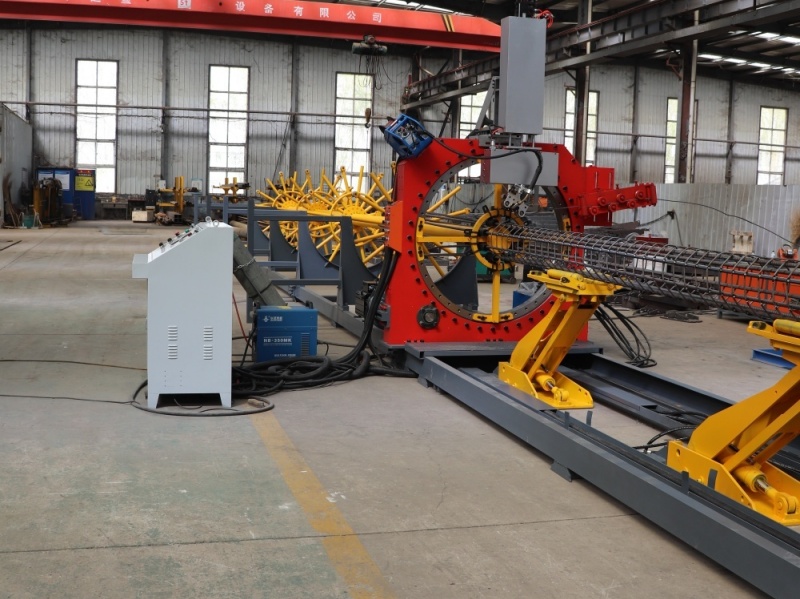
Most production machines fall into one of two mechanical layouts. In a fixed gantry arrangement, the cage rotates in place while the welding carriage travels along a stationary beam. In a travelling carriage arrangement, the welding station moves over a longer bed to cover cage lengths beyond the standard envelope. The first layout is compact and well suited to plants producing a steady mix of medium-diameter cages. The second is easier to extend for long cages, but it demands more floor length and more careful foundation work. The choice should follow the cage length distribution in the order book, not a preference for one layout.
A selection framework that survives an audit
Buyers who get this right tend to work through the same sequence:
Define the working envelope from the drawings, not from the catalogue. List the smallest and largest cage diameter, the longest cage, and the heaviest single cage. Then add a margin for the next project rather than buying exactly to today's maximum.
Convert the programme into cages per shift. Required output, not nominal machine speed, decides whether one welding head is enough or whether a twin-head configuration pays for itself.
State the quality acceptance criteria. Weld size, spiral pitch tolerance, cage ovality and main bar spacing should be written into the technical specification so that acceptance testing is objective.
Agree the automation level deliberately. Bar feeding, cage loading, welding, and unloading can each be manual or automated. Automating welding while leaving loading manual often creates the real constraint.
Check the site services. Connected load, compressed air quality, foundation flatness and available floor length are the four items most often discovered too late.
Price the whole life, not the machine. Consumables, wear parts on clamps and electrode tips, calibration support, spare part lead time and operator training all belong in the comparison.
Where the equipment earns its keep
In pile foundation work, the value is schedule certainty: cages arrive at the rig in sequence, at the right diameter, with consistent spiral pitch, which keeps the concreting cycle moving. On bridge pier and cap projects, the same machine handles the transition between main pile cages and the shorter, stiffer reinforcement units used above ground, provided the recipe system and clamping range allow it. Highway and high-speed rail packages usually add a documentation requirement, so traceable weld parameters and repeatable settings become part of the commercial case. In rebar processing plants serving multiple contractors, the deciding factor shifts again, toward changeover time and the ability to quote short runs profitably.
Matching the machine to the project
Luyuan's automatic rebar cage welding line is built around this selection logic, with configurable cage diameter and length ranges, adjustable main bar clamping, PLC-controlled spiral pitch and optional bar feeding and unloading stations. It suits precast yards, pile cage fabricators and contractors who need repeatable output, and is configured per project rather than sold as a fixed model. Full technical parameters, working envelopes and configuration options are listed on the automatic rebar cage welding machine product page.
FAQ
What is cage welding equipment?
It is a production machine that positions the main reinforcement bars of a cage, rotates or indexes the cage, and welds the spiral bar to the main bars automatically, replacing manual jig welding with a repeatable, PLC-controlled process.
What cage diameter range should a buyer specify?
Specify the full range required by the current order book plus the next planned project, and confirm that the clamping discs and welding head reach both the minimum and maximum diameter without custom tooling.
How is production capacity estimated?
Capacity is cages per shift, from welding time per joint, joints per cage, loading and unloading time and realistic availability. Nameplate rotation speed is not a capacity figure.
Can one machine handle different cage types?
Yes, if it has recipe storage and an adjustable clamping range. Changeover time between cage types is the figure worth asking for in writing.
What information is needed for a quotation?
Cage diameter and length range, main bar count and diameter, spiral bar diameter, required output per shift, site power supply and floor space, so the supplier can propose a configuration rather than a generic model.
Conclusion
Cage welding equipment is a specification decision before it is a purchasing decision. Buyers who define the working envelope, required output, quality criteria and automation level in that order get a machine that fits the programme; buyers who start from a price per unit usually end up paying for the mismatch in changeover time, rework and idle rigs. Send your cage drawings, diameter and length range and target output to the Luyuan technical team to receive a configuration proposal and a project-specific quotation.


