
How Does a Rebar Stirrup Bender Work?
A rebar stirrup bender turns straight or coiled reinforcing steel into accurately shaped stirrups - closed loops that confine the longitudinal bars inside beams, columns and foundations - within one continuous, automated cycle. For fabrication shops and contractors, how this machine works is not a matter of curiosity: it determines the dimensional consistency of every cage, the labor required per shift, and whether output can keep pace with a bridge, rail or foundation schedule. This article explains the working principle step by step, reviews the main machine types, and outlines what matters when choosing equipment, so buyers can match a stirrup bender to real project demands rather than to a specification sheet alone.
Why Stirrup Production Deserves Attention
Stirrups, also called ties or hoops, are the quiet structural backbone of reinforced concrete. They confine longitudinal bars, resist shear forces, and keep the cage stable while concrete is poured and vibrated. A single bridge pier or a stretch of elevated rail deck can require thousands of identically shaped loops. When these are bent by hand, accuracy drifts from piece to piece, output depends on skilled labor that is increasingly hard to find, and the fabrication yard becomes a bottleneck for the whole site.
This is why contractors pay close attention to how a rebar stirrup bender operates. A machine that holds consistent dimensions reduces rework at cage assembly and lowers steel waste. For overseas buyers, the real question is rarely whether a machine can bend a bar at all - it is whether it can repeat the same bend, to the same tolerance, thousands of times, across the exact diameter and shape range the project calls for. Understanding the mechanism makes those differences visible before an order is placed.
The Working Principle: From Coil to Finished Stirrup
Although models differ in capacity, most modern CNC stirrup benders follow the same chain: the bar is fed in, straightened, measured, cut, bent and discharged, with each step coordinated by a programmable controller.
1. Feeding and straightening
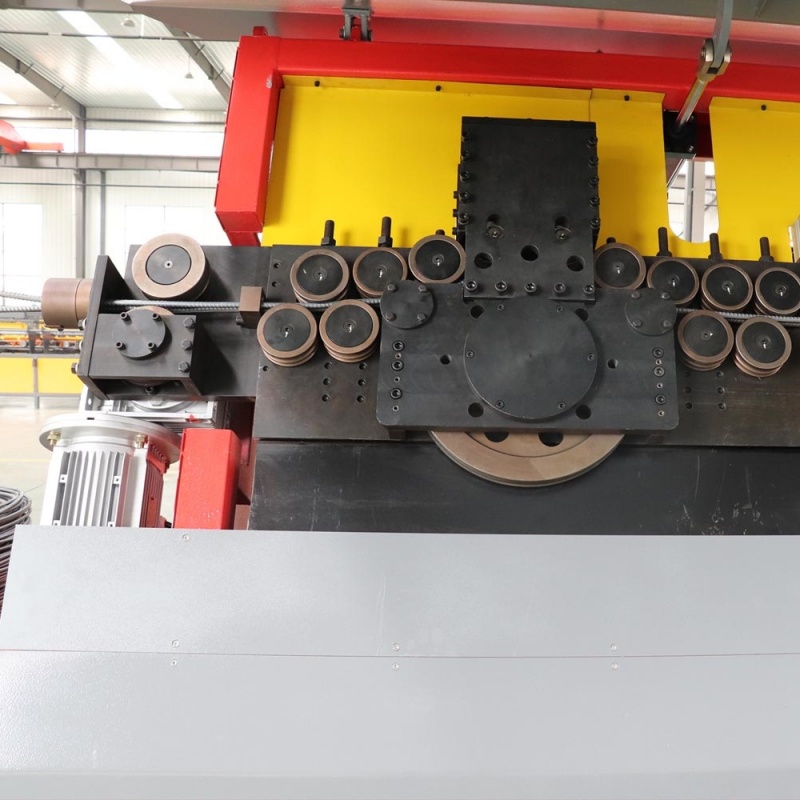
Reinforcing steel usually arrives in coils or long lengths. The machine first pulls it through a straightening assembly, typically rotating rollers that remove the coil's natural curvature. Consistent straightening is essential: any residual bow changes the effective bar length and shifts the bend positions downstream, directly affecting final accuracy.
2. Measurement and cutting
Servo-driven feed rollers advance the bar by a precisely measured amount. The controller, operated through a touch screen, calculates the stirrup's developed length from the entered dimensions and triggers a hydraulic shear at the right moment. Because feeding is measured rather than judged by eye, repeatability does not depend on operator experience.
3. Bending and forming
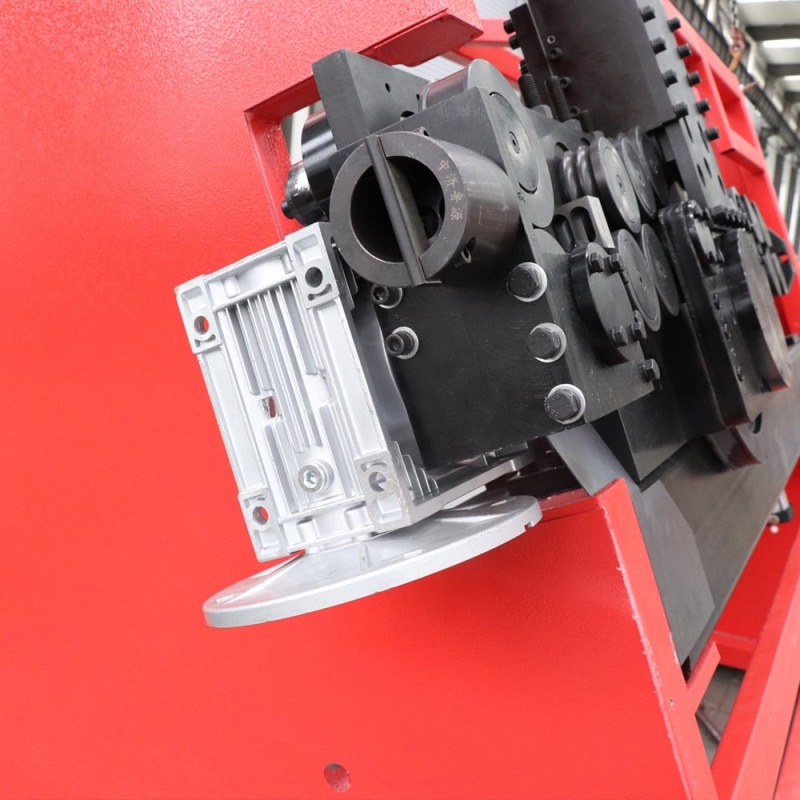
The cut length moves to the bending station, where a rotating pin and fixed formers create the corners. On a CNC stirrup bender, two heads working in opposite directions form complex shapes - double loops, hooks and multi-sided ties - in one program. Angles and dimensions are stored as recipes, so switching sizes means recalling a program rather than resetting mechanical stops.
4. Discharge and collection
The finished stirrup is released onto a rack or conveyor. Optional stacking devices group pieces for tie-up and transport to the cage area, keeping the line moving without manual handling at every cycle.
Automation, Accuracy and What Changes on Site
The value of this mechanism becomes clear when a shop moves from manual bending to an automatic rebar stirrup bender. The first gain is consistency: because feed length and bend angle are controlled electronically, the hundredth stirrup matches the first. The second is flexibility - one machine can run rectangular ties for a foundation and then switch to hooked beam stirrups by changing the program. The third is labor: a small team can supervise several machines and handle only loading, collection and basic maintenance. Steel utilization improves too, as accurate cutting reduces offcuts and trial pieces. These are operational effects observable on site and independent of any market forecast. For buyers assessing efficiency claims, the sensible approach is to request sample dimensions and cycle times for the exact bar diameter and geometry required, then compare them with the project's drawing tolerances.
Applications Across Construction Sectors
Rebar stirrups appear wherever reinforced concrete carries load. In pile foundation work, stirrups and spiral ties confine the vertical bars of the cage, helping it survive handling, lifting and concreting. Bridge piers and cap beams use heavy, closely spaced ties where accuracy affects cover and the fit of the cage inside formwork. High-speed rail projects, with long viaducts and repetitive deck segments, depend on large batches of identical stirrups to a tight schedule. Rebar processing plants serving several sites need variety and fast changeovers, so one line can produce many shapes in a single shift. In every case the requirement is the same: the right shape, to the right tolerance, at a rate that matches placement.
Matching the Machine to Your Fabrication Line
Once the process is clear, selection becomes a question of fit. Start with the bar diameter range and maximum stirrup size the drawings require, then check feeding speed, bending head configuration and the number of stored programs. Consider whether the work is dominated by one repeated shape, which favors a dedicated high-output machine, or by frequent changeovers, which favors a flexible CNC platform. Service support, spare parts and operator training belong in the same decision - a machine that waits weeks for components offers no advantage over manual bending.
Luyuan Machinery's CNC rebar stirrup bender range is built for fabricators who need repeatable accuracy combined with shape flexibility. The machines suit rebar shops, precast yards and contractors handling bridge, rail or foundation work, and are configured around the bar sizes and stirrup geometries each customer actually produces. Reviewing the configurations on the product page is the most direct way to align a machine with a specific fabrication line.
Frequently Asked Questions
Q1. What is a rebar stirrup bender?
A machine that automatically straightens, measures, cuts and bends reinforcing bar into closed or hooked stirrups used to confine longitudinal bars in concrete structures.
Q2. How does a CNC stirrup bender stay accurate?
Servo-driven rollers measure bar length electronically and a controller sets bend angles, so each piece repeats the same geometry regardless of operator experience.
Q3. Can one machine produce different shapes?
Yes. Dual bending heads and stored recipes let one machine run rectangular ties, multi-sided hoops and hooked stirrups, with changeover limited to selecting a program.
Q4. What should I check before choosing one?
Confirm the bar diameter range, maximum stirrup size, production rate, number of programs, and the availability of local technical support and spare parts.
Q5. Where are they most useful?
Where stirrups are needed in large, consistent batches - building beams and columns, pile foundation cages, bridge piers and high-speed rail viaducts.
Summary
A rebar stirrup bender works by straightening, measuring, cutting and bending steel bar under program control, turning a labor-intensive task into a repeatable process. For fabricators that means consistent dimensions, less steel waste and output that keeps up with demanding schedules. If you are evaluating equipment for a bridge, rail, foundation or rebar fabrication project, contact Luyuan Machinery for detailed specifications, technical documentation, configuration advice and a quotation tailored to your bar sizes and stirrup shapes.


