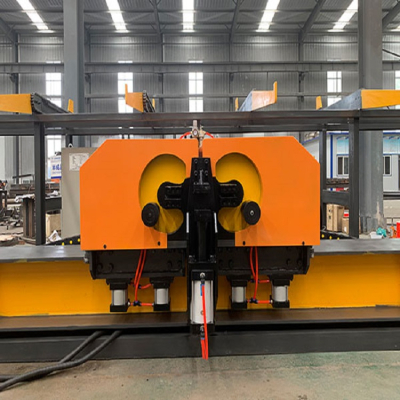
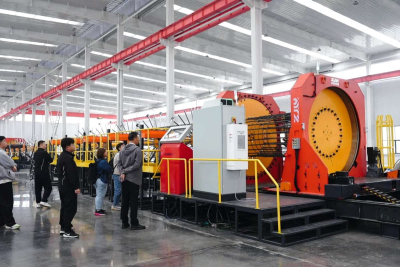
What Is a Rebar Cage Welding Machine?
What Is a Rebar Cage Welding Machine?
A rebar cage welding machine is an automated production system that welds longitudinal main bars and helical spiral reinforcement into a complete reinforcement cage for bored piles, columns and other cast-in-place foundations. If you source cages for piling contractors, bridge projects or a rebar fabrication plant, understanding how this equipment works will help you judge cage quality, compare suppliers and decide whether your workshop should move from manual tying to machine welding. This article explains what the machine is, how it produces cages, where it is used and what to check before you buy one.
Why Cage Quality Matters in Deep Foundation Work
A reinforcement cage is the skeleton of a bored pile. It must keep its shape while being lifted, lowered into a drilling hole filled with mud or slurry, and positioned accurately before concrete is poured. On modern infrastructure projects — highway bridges, high-speed railway viaducts, metro lines and urban overpass foundations — cages are typically 9 to 12 meters long per segment, with diameters from 500 mm up to 2 meters or more.
Traditional cage fabrication is almost entirely manual: workers clamp the main bars on a simple rolling frame, drag the spiral wire along the cage by hand and tack-weld or tie every intersection. The result depends heavily on worker skill. Pitch spacing varies, main bar parallelism drifts, and output per shift is limited by how many welders you can put on the job. In most overseas markets, finding and keeping skilled welders has become harder and more expensive, while project specifications increasingly require consistent pitch and documented quality. This is the gap that the automatic rebar cage welding machine was designed to fill.
How a Rebar Cage Welding Machine Works
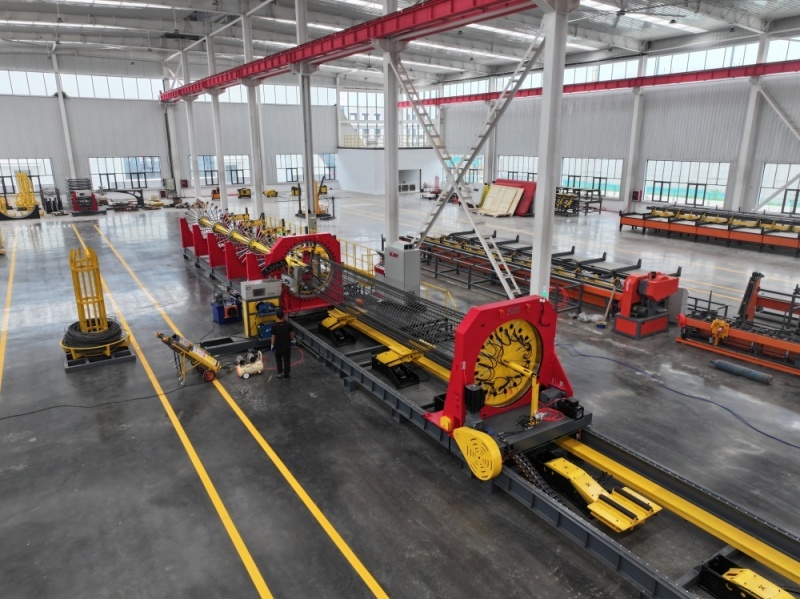
Most machines on the market follow a rotary-welding principle. The main bars are clamped into rotating chucks or fixed supporting plates on both ends of the bed; the cage itself rotates while one or more welding trolleys travel along the bed. In a typical automatic rebar cage welding machine, the process looks like this:
The operator loads the main bars into the movable rotating plate and the fixed rotating plate, and sets the cage diameter, pitch and welding speed on the control panel.
A spiral wire pay-off unit feeds the coiled reinforcement smoothly onto the rotating main bars.
As the cage rotates, MIG/CO2 welding heads weld the spiral wire to the main bars at every intersection, following the preset pitch automatically.
Roller tracks and supporting trolleys carry the growing cage, so long segments can be welded without sagging or oval deformation.
Finished segments are lifted off by crane, and the next cage starts immediately.
Because pitch, rotation speed and travel speed are controlled by PLC, spiral spacing stays uniform and the main bars remain parallel. Welding parameters are set once and repeated on every cage, which is difficult to guarantee in manual production. 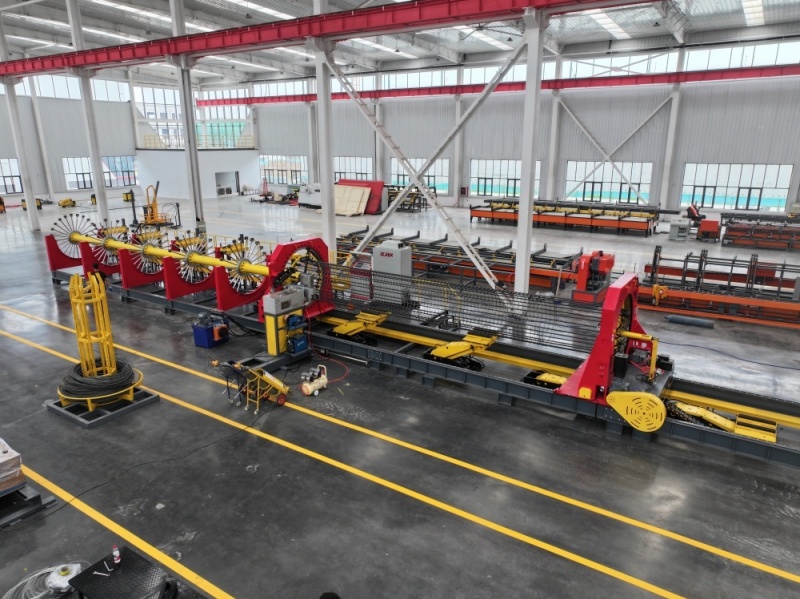
What Buyers Should Compare Before Purchasing
When evaluating a pile cage welding machine, specifications on paper do not always translate into workshop performance. Focus on these points:
Diameter and length range. Check the minimum and maximum cage diameter the chucks and supporting rollers accept, and the maximum segment length your lifting equipment and site logistics allow. A machine that covers 500–2000 mm covers most bridge and building pile work.
Welding system. Number of welding guns, brand of the welding power source, and whether double-gun configuration can weld two cages or two positions in parallel for higher output.
Automation degree. Servo-driven pitch adjustment, automatic spiral feeding and hydraulic clamping reduce the crew per machine to two or three operators.
Frame rigidity and track precision. The bed carries several tons of rotating steel; a rigid structure and machined track are what keep cages straight over years of use.
After-sales support. Spare parts availability, remote commissioning and English-language documentation matter a lot for overseas buyers.
Where the Machine Delivers the Most Value
The equipment fits several typical scenarios. In piling projects for buildings and industrial plants, a fabricator can supply consistent 12-meter cage segments on schedule, matching the drilling crew's rhythm. On bridge and viaduct projects, large-diameter cages for main piers benefit most from uniform pitch and strong, clean welds. High-speed railway foundations demand strict quality control, and machine-welded cages make inspection straightforward because every cage is produced with the same parameters. Finally, in a central rebar processing plant that serves multiple projects, one cage welding line together with cutting and bending equipment turns scattered manual work into a controlled production flow, which is how modern processing yards in Southeast Asia, the Middle East and Africa are upgrading.
Luyuan Machinery's Automatic Rebar Cage Welding Machine
For buyers looking for a proven configuration, the automatic rebar cage welding machine from Luyuan Machinery is a practical reference. It uses a double-plate rotating design with servo-controlled pitch, a spiral wire pay-off stand and adjustable MIG welding trolleys, producing cages for diameters and lengths commonly required by piling and bridge contractors. It suits rebar processing plants, piling subcontractors and construction companies that currently rely on manual cage fabrication and want stable daily output with a small crew. Technical parameters, cage samples and configuration options are listed on the product page, and the sales team can recommend the right diameter range and welding setup for your project portfolio.
Frequently Asked Questions
1. What is a rebar cage welding machine used for?
It welds main bars and spiral reinforcement into complete reinforcement cages used in bored piles, cast-in-place columns and other deep foundation elements for buildings, bridges, railways and metro projects.
2. How is a machine-welded cage better than a manually tied one?
The pitch, main bar spacing and welding points are controlled by PLC, so every cage is uniform and welds are consistent. Manual quality varies with worker skill, and output is limited by the number of welders.
3. What cage diameters and lengths can it produce?
Typical models cover cage diameters from about 500 mm to 2000 mm and segment lengths up to 12 meters. Confirm the exact range with the manufacturer against your project drawings.
4. How many workers does one machine need?
Usually two to three operators: one at the control panel and welding trolley, plus helpers for loading bars and lifting finished segments.
5. How much does a rebar cage welding machine cost?
Price depends mainly on the diameter range, bed length, number of welding guns and automation options. Ask the manufacturer for a quotation based on your cage drawings and required daily output.
Summary
A rebar cage welding machine replaces manual tying and tack-welding with a PLC-controlled rotary welding process, delivering uniform pitch, consistent welds and stable output for piling, bridge and railway foundation work. For contractors and rebar processors still fabricating cages by hand, it is now the standard route to reliable quality and lower labor dependency. If you want to check technical parameters, compare configurations or get a quotation for your cage drawings, visit the product detail page or contact Luyuan Machinery's sales team for a tailored solution.