Rebar Cage Manufacturing Trends in Modern Construction
Rebar cage manufacturing is moving from a craft-like workshop activity toward a controlled production process, and the change is most visible where pile, bridge and rail projects demand repeatable output under tight schedules. For overseas buyers, the trend is not a matter of following a fashion: it changes how a fabrication plant quotes work, how it verifies quality and how reliably it can deliver cages to a drilling crew. This article examines what is actually changing in cage production, why those changes matter when equipment is purchased, and which technical points should be checked before committing to an automatic welding line.
Industry background: why the trend is happening
A reinforcement cage is assembled from longitudinal main bars and a continuous spiral bar. On a cast-in-place bored pile, that cage is lowered into the borehole before concrete is placed; on a bridge or rail structure, it becomes part of a foundation or column that will carry load for decades. The component is hidden after construction, so its quality is judged before pouring, through dimensional checks and inspection of the joints between spiral and main bars.
Traditional fabrication relies on jigs and manual positioning. Skilled teams can produce good cages, but results depend on the people on the shift, and a long cage with many joints offers room for small deviations. Contractors now ask for shorter delivery windows, larger diameters and stricter documentation, while retaining enough operators for manual welding benches is difficult in many markets. These pressures explain why rebar cage manufacturing is being reorganized around machines that control rotation, pitch and welding as one repeatable sequence.
For an overseas buyer, the practical question is whether that controlled process fits the project mix: repetitive bored-pile work benefits most, while one-off shapes may still be made by hand.
The technical shift: from jig welding to controlled production
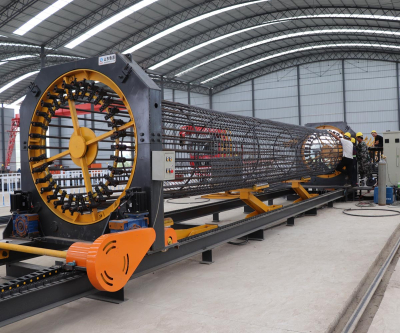
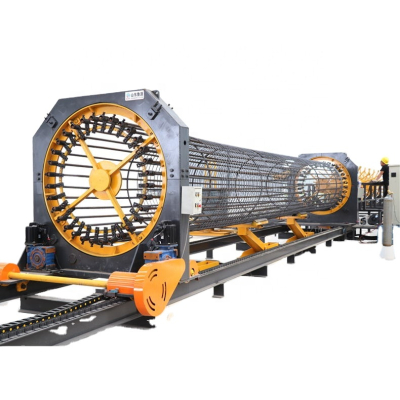
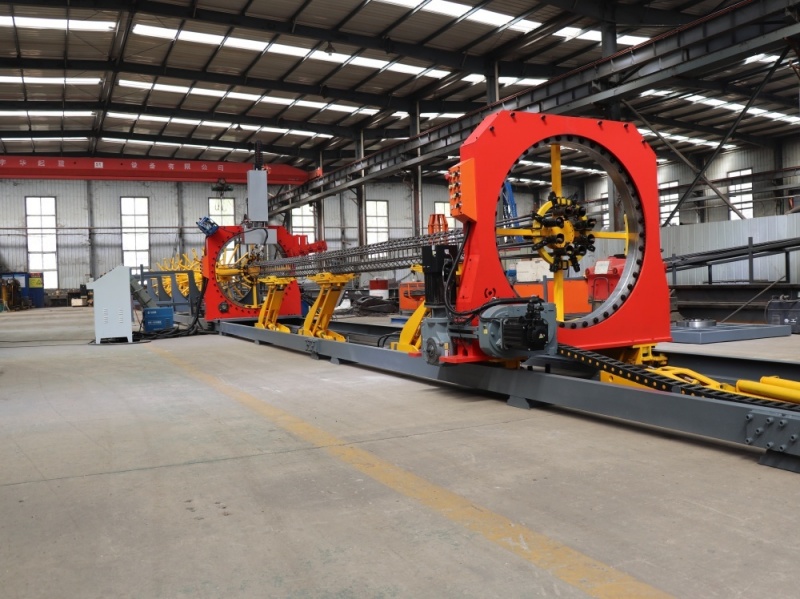
An automatic cage welding machine holds the main bars in a circular array on adjustable clamping discs, then rotates the assembly around its axis while a travelling welding head advances along the cage. The spiral bar is fed through a guide and welded at each crossing with a main bar. A controller coordinates rotation speed, carriage travel and welding output, so the pitch of the spiral is determined by settings rather than by the operator's hand. The operator straightens and loads the bars, fixes the spiral start, enters the parameters for the drawing and starts the cycle.
The engineering details decide how well that works. Shaft rigidity and support spacing influence deflection on long or large-diameter cages. Clamping disc design affects how quickly the main-bar count can change; the spiral guide must prevent drift over a long run, and the welding head has to maintain stable contact at each crossing. Controlled discharge of the finished cage and safe handling at the tail are part of a practical line, not extras.
Process control is the real change. When pitch, rotation and travel are linked, the machine repeats the same geometry from the first cage to the last, making inspection more predictable and reducing rework from inconsistent joints. Automation does not remove inspection, but it makes the output easier to verify and gives the plant a clearer record of how each cage was made.
Where the equipment is used
In pile foundation work, the dominant requirement is continuity: cages must be ready as the piling rigs advance, and a cage that fails inspection interrupts the whole sequence. Automatic production fits this pattern because the same drawing can be repeated with stable parameters. In bridge construction, cages are often larger and heavier, so rigidity of the machine and safe handling of the finished cage matter as much as welding speed. High-speed rail projects add long production runs and strict acceptance checks, where a steady process is more valuable than occasional bursts of output.
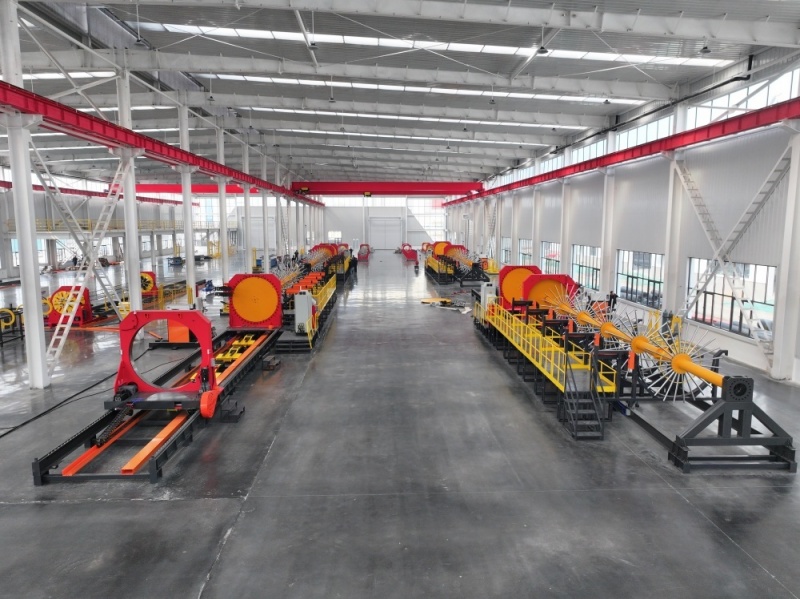
In a fabrication plant serving several sites, the benefit is scheduling control: projects can be queued with parameters stored for each drawing. The same equipment supports highway, port, metro and column cage work wherever circular reinforcement is specified. Across these applications, the value is a predictable supply of finished cages.
What buyers now look at
The selection trend is moving away from a single headline capacity figure. Serious buyers start with the drawing envelope: minimum and maximum cage diameter, longest cage, main-bar diameter and count, and the required spiral pitch range. A machine specified only near the top of its range can perform poorly on smaller cages. If a plant serves both bridge piles and smaller foundation jobs, the useful measure is the breadth of the working range and how quickly the machine moves between settings.
Changeover and support come next. Ask how main-bar positions are reset, whether common recipes can be stored, and what wear parts are needed over a season. For overseas purchasers, spare-parts availability and clear commissioning instructions can matter more than a catalogue figure; a trial based on typical drawings is the most reliable check.
How Luyuan equipment fits this trend
Luyuan Machinery builds cage welding equipment for fabricators and contractors who need repeatable output without sacrificing configuration flexibility. The automatic rebar cage welding machine is designed for operations that produce cages regularly: it handles main-bar alignment, consistent spiral pitch and controlled welding in one sequence. It suits reinforcement fabrication plants serving multiple sites, pile contractors with steady bored-pile workloads, and bridge or rail packages with sustained demand.
Configuration should start with real drawings and the shift plan. A plant with a narrow diameter range can prioritize throughput; one serving varied projects should weight adjustable clamping, pitch range and stored parameters more heavily. Discussing bar grades and daily targets before ordering avoids paying for unused capability.
Frequently asked questions
What is rebar cage manufacturing?
It assembles longitudinal bars and a spiral bar into a cylindrical cage for piles, columns and foundations. Automatic lines weld each crossing in a controlled cycle instead of by hand.
How does an automatic machine differ from manual cage fabrication?
A controller links rotation, spiral feed and welding, so pitch and joints repeat from settings. Manual work depends on operator technique and suits very small batches or unusual shapes.
Which projects benefit most from automatic cage production?
Repetitive geometries with steady demand, such as bored-pile packages, bridge foundations and high-speed rail structures. Plants supplying several sites also benefit from queued production.
What should I check before choosing a machine configuration?
Check diameter and length range, main-bar count and size, pitch settings, changeover method and spare parts. Match them to your drawings, not a single capacity figure.
Can one line handle different diameters and pitches?
Yes, if the required values fall within the working range and clamping can be reset efficiently. Confirm the drawing envelope with the manufacturer before ordering.
Final thoughts
Rebar cage manufacturing is becoming a question of process control, not manual skill alone. Drawing range, changeover behaviour and supplier support decide whether a line performs. Send typical cage drawings and your target output per shift, then request technical parameters and a configuration. Luyuan Machinery can provide specifications and a quotation based on your requirements - contact the team to discuss the right equipment.