
Buying a Rebar Cage Machine for Industrial Production
Buying a rebar cage machine for industrial production is a capacity decision, not simply a purchase of welding equipment. The machine determines the pitch accuracy of the spiral bar, the consistency of every main-bar joint, and the rate at which a fabrication plant can turn reinforcement drawings into finished cages for bored piles, bridge foundations and high-speed rail structures. A specification that overlooks any one of those factors will restrict output long before the equipment reaches its rated speed.
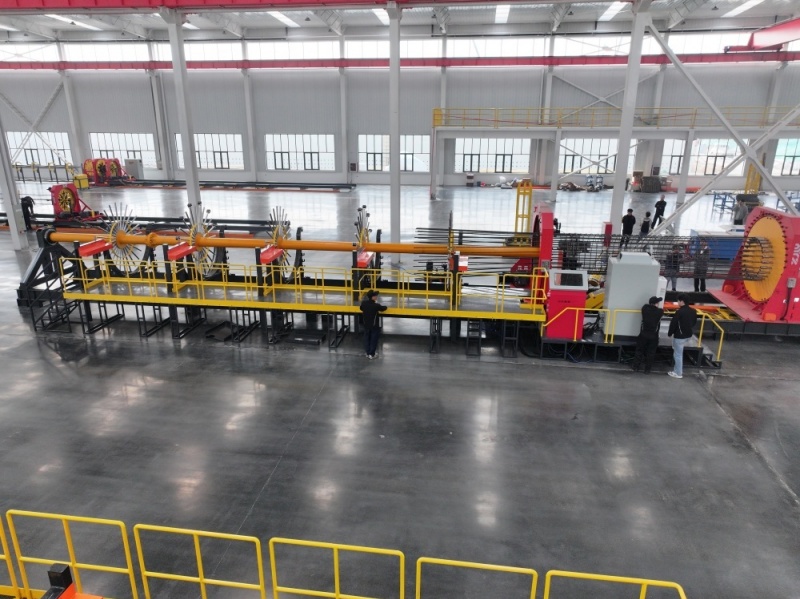
Why the buying decision deserves engineering attention
Reinforcement cages are structural components, not temporary assemblies. On a cast-in-place bored pile, the cage must arrive straight, correctly pitched and with joints that survive lifting and concrete placement. A cage that fails dimensional inspection has to be rebuilt, and the pile programme absorbs the delay. This is why procurement teams evaluate a rebar cage machine against finished-product requirements and the production schedule, not purchase price alone.
The buyer's intent usually reflects a real constraint: a plant has won a package with a fixed delivery window, or an existing manual jig line can no longer keep pace with the piling rigs on site. The practical question is the same - can the machine hold tolerance while delivering the required cages per shift, and can it be changed over when drawings change?
How an automatic rebar cage machine works
An automatic rebar cage machine holds longitudinal main bars in a circular array with adjustable clamping discs, rotates the assembly on a driven shaft, and welds the spiral bar to each main bar as a travelling head advances along the cage axis. A programmable controller coordinates rotation, carriage travel and welding output so pitch stays uniform end to end. The operator loads straightened bars, fixes the spiral start, enters the parameters and starts the cycle; the machine completes the weld path with far less manual positioning than a jig-based operation.
The details separate an industrial machine from a light-duty one. Main-shaft rigidity and the support arrangement govern cage deflection at larger diameters; clamping disc design determines how quickly the bar count can be changed. The welding head must keep stable contact as the spiral crosses each main bar, while the controller holds rotation and travel in sync when pitch changes. Buyers should also check how the cage tail is handled, how the finished cage is discharged, and whether the guide mechanism prevents spiral drift during long runs.
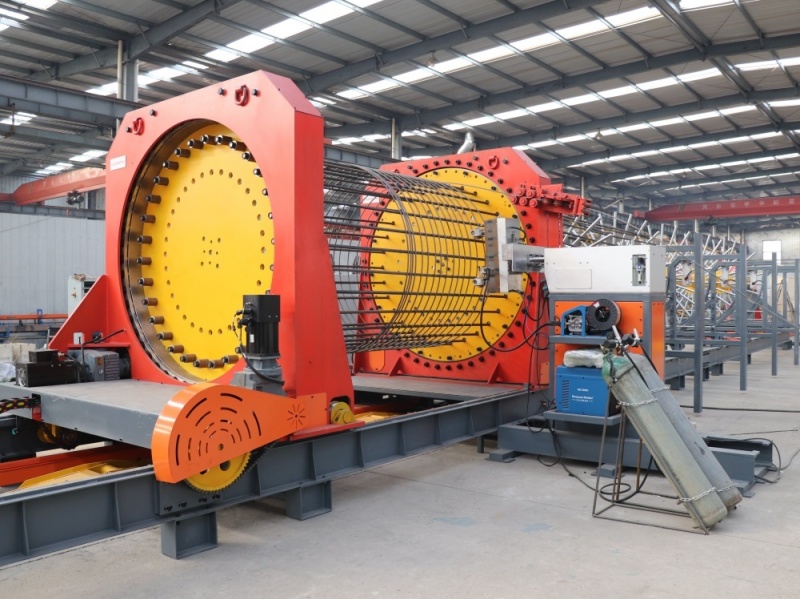
Specification points that decide real productivity
Start with the drawing envelope: minimum and maximum cage diameter, longest cage required, main-bar diameter and count, and spiral pitch range. A machine specified only at the top of its range often performs poorly on small-diameter cages. If a plant serves both bridge piles and smaller foundation jobs, the useful question is how broad the working range is, not the largest advertised diameter.
Next, look at changeover time. Projects introduce different bar grades, diameters and pitch requirements, and every changeover is non-productive time. A sensible rebar cage machine configuration lets the operator reset main-bar positions and pitch parameters without dismantling major assemblies. Clearly marked adjustment points and a controller that stores common recipes reduce the learning curve for new operators.
Then examine the support side. Welding wire, power demand, spare contact parts and routine maintenance all influence cost per cage. A machine that is difficult to service will lose shift time over a working year. Ask which wear parts are supplied, what maintenance intervals apply, and whether spares can be shipped with the initial order - for overseas buyers this is often more valuable than a headline production figure.
Where the equipment earns its place
In pile foundation work, the dominant requirement is repeatability: cages must meet the same dimensional tolerance and be ready as the drilling crew moves on. In bridge construction, cages are larger and heavier, so support rigidity and safe handling matter as much as welding speed. High-speed rail projects add strict inspection and long runs, where a stable process beats occasional bursts of high output. A rebar cage machine in a reinforcement fabrication plant ties these demands together, because the plant must queue multiple projects and protect delivery dates.
The same equipment supports highway, port and metro projects with bored piles or column cages. The value is consistent: replace variable manual work with a controlled process and give the site a predictable supply of finished cages, with better control of schedule and quality verification.
How Luyuan equipment fits an industrial line
Luyuan Machinery supplies automatic cage welding equipment for fabricators and contractors needing a balance between working range, stability and configuration flexibility. The automatic rebar cage welding machine is intended for operations that produce cages repeatedly: it handles main-bar alignment, consistent spiral pitch and controlled welding in one sequence. It suits rebar fabrication plants serving several sites, pile contractors with steady bored-pile workloads, and bridge or rail packages with sustained demand.
Selecting the right configuration depends on the drawings and shift plan. A plant handling a narrow diameter range can prioritize throughput; one serving varied projects should prioritize adjustable clamping, a wider pitch range and stored parameters. Discussing bar grades, cage dimensions and daily output targets before ordering avoids paying for unused capability - or discovering too late that a required diameter sits outside the working range.
Frequently asked questions
What is a rebar cage machine used for?
It assembles main bars and a spiral bar into a cylindrical reinforcement cage for bored piles, bridge foundations and columns. Industrial models weld the spiral to the main bars automatically instead of relying on manual tying.
How do I choose the right cage diameter and length range?
Base the decision on your current drawings plus realistic future projects, not on the largest number in a catalogue. Check minimum diameter, maximum length, main-bar count and pitch range together, because a machine optimized for one end of the range may perform less well at the other.
Is an automatic machine better than manual cage fabrication?
For repetitive production, automatic welding gives more consistent pitch and joint quality and reduces dependence on operator technique. Manual fabrication still suits very small quantities or unusual one-off shapes where setup would take longer than building the cage by hand.
What affects the price of an industrial rebar cage machine?
Working range, shaft and clamping design, number of welding heads, control features and the spare-parts package all influence cost. Transport and commissioning should be quoted separately so the total investment is clear before purchase.
Can one machine serve both bridge and high-speed rail projects?
Often yes, provided the required diameters, bar sizes and pitch settings fall within the machine's range and the controller can store different process recipes. Confirm the drawings with the manufacturer before ordering.
Final thoughts
A rebar cage machine should be selected as part of a production system: drawing envelope, changeover behaviour, welding consistency and supplier support all matter. The most useful next step is to send typical cage drawings and your target output per shift, then request the corresponding technical parameters and a project-specific configuration. Luyuan Machinery can provide detailed specifications, technical documentation and a quotation based on your actual production requirements - contact the team to discuss the right configuration for your plant.


