Operation Process of Rebar Cage Rolling Welder
The operation process of the rebar cage rolling welder is designed to be simple, efficient and safe, fully leveraging the machine’s intelligent PLC control, servo drive and automatic welding systems. This process ensures that operators can complete high-precision rebar cage production with minimal professional skills, while maintaining the machine’s stability and processing quality. The following is the standard step-by-step operation process, which is applicable to all models of our rebar cage rolling welder (supporting 400mm~2500mm cage diameter and three welding combinations).
1. Pre-Operation Preparation (5-10 Minutes)
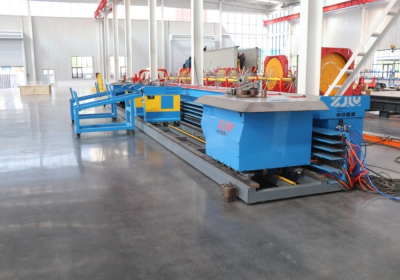
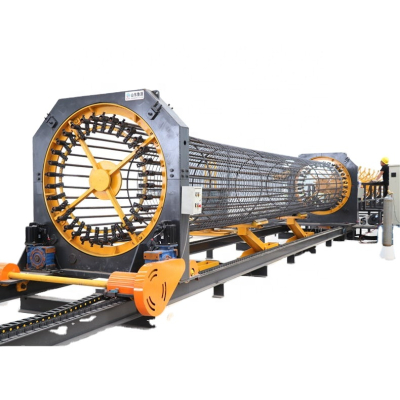
Equipment Inspection: Check the overall structure of the machine, including the frame, fixed circling disk, moving disk, support roller and rim (optimized high-strength seamless steel pipe structure). Ensure there is no looseness, deformation or damage to key components. Verify that the dual-gun synchronous welding system, laser positioning sensor and full-closed-loop control system are in normal working condition.
Safety Check: Confirm that the emergency stop button, audible and visual alarm system and welding fume extraction system are functional. Check the power supply, voltage (customized according to local standards) and circuit connections to avoid short circuits or electric leakage. Wear personal protective equipment (PPE) including welding gloves, goggles and anti-slip shoes.
Material Preparation: Prepare main bars (12-32mm diameter) and stirrups (6-16mm diameter) that meet project specifications. Cut the main bars to the required length (9-12m standard, customizable to 18-22m) and straighten them to ensure no bending or rust, which may affect welding quality.
Template Installation: According to the pre-determined rebar cage diameter, install the corresponding template on the machine. Ensure the template is fixed firmly and the casing spacing (matching the number of main bars) is set correctly. Template replacement (for different cage specifications) takes about 1 hour, as designed for quick switching.
2. Parameter Setting (2-3 Minutes)
Invoke or Set Parameters: On the touch screen, either invoke pre-stored parameter data (including cage diameter, length, main bar spacing, stirrup density and welding time) or set new parameters according to project requirements. The welding time of each solder joint can be flexibly configured and saved, ensuring consistency with process standards.
Synchronization Calibration: Confirm that the PLC frequency conversion control and multi-frequency converter are coordinated, ensuring perfect synchronization of the fixed circling disk, moving disk and motor movements. Calibrate the laser positioning sensor to ensure the positioning accuracy of main bars and stirrups (error within ±5mm).
Welding Parameter Adjustment: Set the welding current, voltage and welding time according to the rebar specifications. The machine’s intelligent optimization algorithm will automatically adjust parameters to avoid false welding, missing welding and weld porosity, while reducing welding material waste by 15%.
3. Automatic Production Operation (20-40 Minutes per Cage)
Main Bar Feeding: Place the prepared main bars into the automatic main bar feeding system. The system will automatically feed and position the main bars according to the preset spacing, guided by the laser positioning sensor. The main bars are fixed firmly on the template to ensure no displacement during welding.
Stirrup Tensioning and Winding: The stirrup tensioning system straightens and tensions the stirrups, then the winding system winds the stirrups around the main bars at the preset density. The optimized rim structure and support roller ensure stable rotation, reducing operating inertia and ensuring uniform winding.
Automatic Welding: The dual-gun synchronous welding system starts welding the main bars and stirrups. The welding time of a single main bar is controlled within 35 seconds, and the entire welding process is monitored by the full-closed-loop control system. During welding, the moving disk drags the rebar cage skeleton backward, while the disc bar remains fixed to avoid friction and wear.
Real-Time Monitoring: Operators monitor the machine’s operation status through the touch screen, including processing progress, welding parameters and equipment running status. The real-time monitoring and data recording system automatically records all operation information. If abnormal parameters or faults are detected, the system will immediately issue an audible and visual alarm and stop operation.
4. Finished Product Inspection and Unloading
Quality Inspection: Check the overall size, main bar spacing, stirrup density and weld joints of the finished rebar cage. Ensure the diameter error is within ±10mm, the stirrup spacing error is within ±5mm, and there is no false welding, missing welding or porosity. The traceable data from the monitoring system can be used for quality verification.
Unloading: Use the machine’s traction device (customizable for heavy cages) to safely unload the finished rebar cage. Place the cage in the designated area, avoiding collision or damage. For extra-long cages (18-22m), ensure stable unloading with the help of auxiliary equipment.
5. Post-Operation Maintenance
Shutdown Procedure: Turn off the machine power supply and air source (if applicable) in sequence. Clean the welding fume extraction system, remove welding slag and debris from the welding guns, template and support roller.
Routine Maintenance: Apply lubricating oil to the moving parts (such as the support roller and feeding system) to reduce friction. Check the wear of the welding guns and die heads, and replace them if necessary. Inspect the circuit and pipeline connections for looseness.
Data Backup: Back up the parameter data on the touch screen to avoid data loss. Record the machine’s operation time, processing quantity and any faults encountered, which can be used for after-sales maintenance and performance optimization.