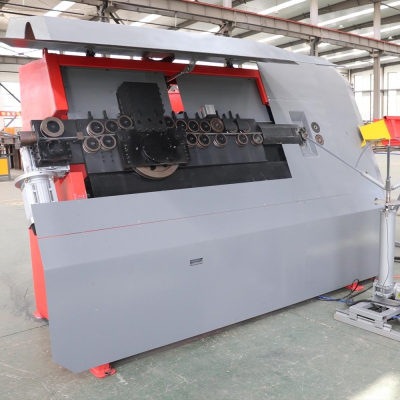
Steel Cage Welding Machine: Purchase Selection Guide & LYGH-1250D Model Introduction
As a high-performance model in the steel cage welding machine product line, the LYGH-1250D Steel Cage Welding Machine has won wide recognition in the market with its high automation, wide processing range, and flexible configuration advantages. It is especially suitable for processing steel cages with a pile diameter of less than 1.25 meters, and is widely used in small and medium-sized pile foundation projects such as rural highways, urban pipe networks, and small bridges.
Product Details
As a core equipment in modern reinforcement processing, the steel cage welding machine plays a decisive role in ensuring the quality and efficiency of infrastructure projects such as highways, high-speed railways, and bridges. However, the types and specifications of steel cage welding machines are diverse, and the processing requirements of steel cages vary greatly according to different engineering designs. If the model is improperly selected during purchase, it will not only fail to meet the actual processing needs but also cause problems such as low production efficiency, high equipment wear, and increased construction costs. Therefore, mastering scientific selection methods is the premise of purchasing a suitable steel cage welding machine. Generally speaking, the selection of steel cage welding machines should be based on three core dimensions: pile diameter matching, winding method requirements, and main reinforcement arrangement. On this basis, we will introduce the high-performance LYGH-1250D Steel Cage Welding Machine in detail.
Core Selection Criteria for Steel Cage Welding Machines
1. Model Selection Based on Pile Diameter
The pile diameter of the project is the most basic and core factor determining the model of the steel cage welding machine. Different models of welding machines correspond to different maximum processing pile diameters. At present, the common models of steel cage welding machines on the market are divided according to the applicable pile diameter: Type 1250, Type 1500, Type 2000, Type 2200, Type 2500, and Type 3000. The model number directly corresponds to the maximum applicable pile diameter (unit: mm). For example, Type 2000 can stably process steel cages with a pile diameter of less than 2 meters, which is suitable for medium-sized pile foundation projects such as urban roads and general bridges; Type 2500 is applicable to steel cages with a pile diameter of less than 2.5 meters, which is often used in large-scale bridge foundations and high-speed railway subgrade projects with higher bearing capacity requirements. When purchasing, the construction party must first clarify the pile diameter parameter of the steel cage in the engineering drawings, and select the corresponding model according to the principle of "matching the maximum pile diameter with a proper margin". It should be noted that it is not advisable to choose a model with excessive surplus, as it will lead to waste of equipment performance and increase energy consumption during operation.
2. Selection Based on Winding Method
The winding method of the steel cage's stirrups directly affects the structural stability and bearing capacity of the pile foundation, and different winding methods require corresponding equipment configurations. According to the number of stirrup winding bars, it can be divided into two types: single-bar winding and double-bar winding. Single-bar winding is suitable for general engineering scenarios with relatively low requirements on the bearing capacity of the steel cage; double-bar winding has higher structural strength and stability, and is often used in key projects such as high-speed railways, large bridges, and deep foundation pits that have strict requirements on pile foundation quality. During the purchase process, the construction party must clearly inform the manufacturer of the specific requirement of the steel cage on the engineering drawings—whether it is single-bar winding or double-bar winding. This is because the internal transmission mechanism, welding head layout, and control system parameters of the welding machines corresponding to the two winding methods are quite different. If the winding method is not clearly stated, the delivered equipment will be unable to meet the drawing requirements, resulting in rework and delays in the project progress.
3. Selection Based on Main Reinforcement Arrangement
The main reinforcement is the core load-bearing component of the steel cage, and its arrangement method directly determines the structural design of the steel cage welding machine's main reinforcement feeding system. At present, the main reinforcement arrangement of steel cages is mainly divided into single-bar arrangement and double-bar arrangement. Due to the structural design characteristics of the steel cage rolling welding machine, the main reinforcement needs to be manually inserted into the dedicated guide tube during processing, and the guide tube must be completely matched with the main reinforcement arrangement. Specifically, if the main reinforcement of the steel cage is arranged in a single-bar manner, the equipment needs to be equipped with a single-bar guide tube; if the main reinforcement is arranged in a double-bar manner, a double-bar guide tube is required. The guide tube is a customized component that cannot be universally used between different arrangements. Therefore, when purchasing, the construction party must clearly describe the main reinforcement arrangement requirements on the drawings to the manufacturer, so that the manufacturer can configure the corresponding guide tube to ensure the smooth progress of the main reinforcement positioning and welding process.
Detailed Introduction to LYGH-1250D Steel Cage Welding Machine
As a high-performance model in the steel cage welding machine product line, the LYGH-1250D Steel Cage Welding Machine has won wide recognition in the market with its high automation, wide processing range, and flexible configuration advantages. It is especially suitable for processing steel cages with a pile diameter of less than 1.25 meters, and is widely used in small and medium-sized pile foundation projects such as rural highways, urban pipe networks, and small bridges.
The core advantage of the LYGH-1250D Steel Cage Welding Machine is its high degree of automation. The equipment adopts advanced PLC numerical control system, which can realize automatic control of the entire process from main reinforcement positioning, stirrup winding to welding forming. Compared with traditional semi-automatic equipment, it greatly reduces manual intervention, not only liberates the labor force (the number of operators can be reduced from 5-6 to 2-3) but also avoids quality problems caused by human factors. The processed steel cages have uniform stirrup spacing, firm welding points, and beautiful overall forming, fully meeting the requirements of the national *Code for Construction Quality Acceptance of Concrete Structure Engineering*.
In terms of processing range, the LYGH-1250D Steel Cage Welding Machine has strong adaptability. It can process main reinforcements with a diameter of 12-32mm and stirrups with a diameter of 6-12mm, and can flexibly adjust parameters according to different engineering requirements to realize the processing of steel cages with different lengths and specifications. At the same time, the equipment supports flexible configuration options—customers can choose to match the double-gun welding robot according to their own production efficiency requirements. The double-gun welding robot adopts synchronous welding technology, which can complete the welding of two welding points at the same time, and the welding efficiency is increased by more than 50% compared with the single-gun model. It is especially suitable for projects with tight construction schedules and large steel cage processing volumes.
In addition, the LYGH-1250D Steel Cage Welding Machine also has the characteristics of stable operation and easy maintenance. The main frame is made of high-strength steel, which has strong bearing capacity and can withstand long-term high-intensity operation; key components such as welding electrodes and servo motors are selected from well-known brand products, with a long service life and low failure rate. The equipment is equipped with a humanized operation interface, and the parameter setting is simple and intuitive. New operators can master the basic operation skills after short-term training. The manufacturer provides a complete after-sales service system, including equipment installation, commissioning, training, and maintenance, to ensure the stable and continuous operation of the equipment in the construction site.
To sum up, the selection of steel cage welding machines must be based on the actual engineering requirements, and the model should be determined scientifically through the three core dimensions of pile diameter, winding method, and main reinforcement arrangement. The LYGH-1250D Steel Cage Welding Machine, with its high automation, wide processing range, and flexible configuration, provides an efficient and reliable solution for small and medium-sized pile foundation projects. It is an ideal choice for construction enterprises pursuing high-quality and efficient reinforcement processing.
Leave your messages