As the most fundamental yet critical link in the construction industry, rebar bending has long relied on manual operations. Skilled workers, with years of experience and a keen sense of touch, bend and shape each piece of rebar.
However, this traditional method suffers from pain points such as low efficiency, poor product consistency, and high labor intensity, making it increasingly difficult to meet the modern construction industry’s growing demands for precision and efficiency.
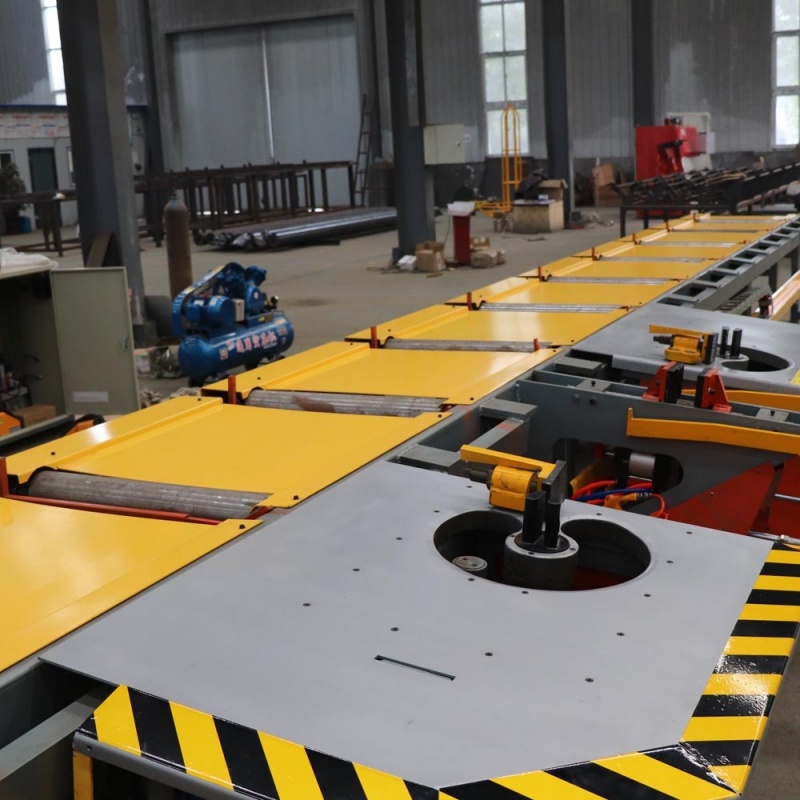
The CNC horizontal inclined-plane rebar bending center emerges as a product of this context. As a high-end rebar processing equipment integrating material feeding, length measurement, angle setting, automatic bending, and cutting, it adopts a horizontal structural layout and an intelligent CNC system. This enables flexible processing of stirrups and special-shaped rebars with different inclination angles.

The core advantage of the CNC horizontal
rebar bending center lies in its precise control capability. Through multi-axis servo linkage to accurately control each process, the equipment can strictly limit the bending angle error to within ±1 degree and the length error to no more than ±2 millimeters.
Take the intelligent rebar processing center at the beam fabrication yard of the Xiong’an-Xinzhou High-Speed Railway as an example. Its CNC horizontal rebar
bending center works in synergy with servo motors and high-precision sensors to monitor the processing path in real time and make dynamic adjustments, fundamentally improving product consistency.
In terms of efficiency, the processing speed of CNC equipment can reach three to four times that of traditional processes. The entire processing flow operates continuously without human intervention, significantly reducing labor and time costs.
Compared with vertical equipment, the horizontal inclined-plane rebar bending center has obvious advantages in design. The patent for "Horizontal Inclined-Plane Rebar Bending Center" obtained by Shandong Zhongji Luyuan Machinery showcases the innovative features of this equipment.
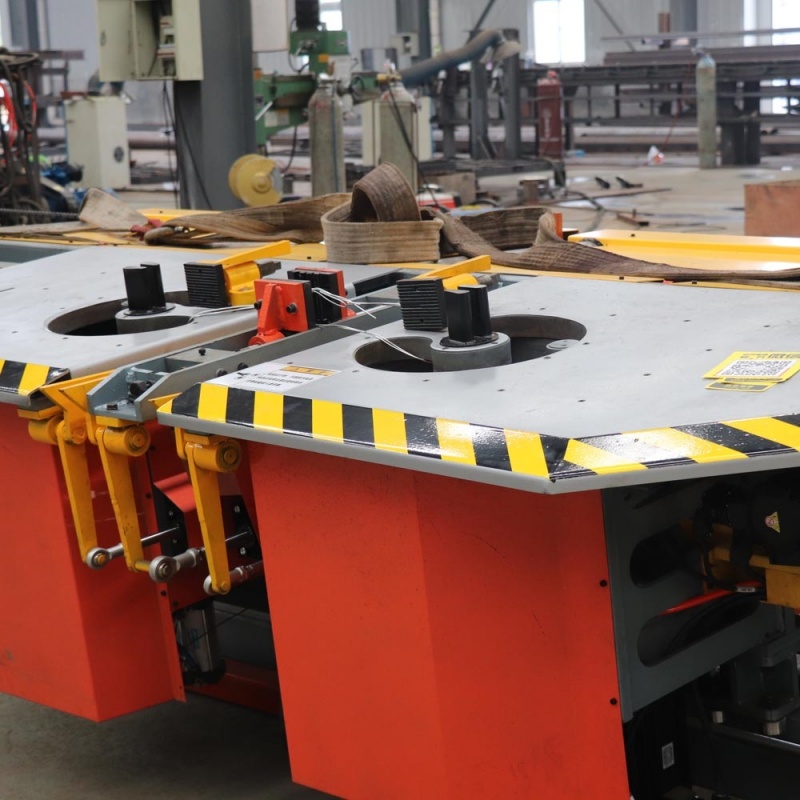
The equipment includes a material storage rack. A material storage bin is arranged on the top of the material storage rack along its length direction, and a bending mechanism is slidably installed on one side of the material storage rack along the length direction of the rack.
When bending rebars, bundled rebars are lifted and placed in the material storage bin. The two bending heads on the material storage rack are moved to appropriate positions where the rebars need to be bent. Workers manually transport the rebars to between the fixed molds and movable mold columns on the two bending heads. After the rebars are bent, the workers take the rebars out of the fixed molds and movable mold columns and place them in the blanking bin.
According to research data from QYResearch, the global market size of CNC horizontal inclined-plane bending centers was approximately 70 million US dollars in 2024. It is expected to reach 118 million US dollars by 2031, with a compound annual growth rate (CAGR) of 7.8% during the period.
This growth trend is closely related to the global construction industry’s shift toward prefabricated construction. The CNC horizontal inclined-plane rebar bending center is particularly suitable for prefabricated construction projects that have extremely high requirements for component size precision and geometric angles.
From a geographical perspective, North America, Europe, and the Asia-Pacific region are the major markets for CNC horizontal inclined-plane bending centers. Among them, the Asia-Pacific region is experiencing particularly rapid growth in market demand due to the continuous investment in infrastructure construction in countries such as China and India.
In recent years, domestic and foreign enterprises have increased their R&D efforts, driving continuous innovation in
CNC rebar bending center technology.
The patents for the horizontal inclined-plane rebar bending center by Shandong Zhongji Luyuan, the rebar bending device by China Railway 19th Bureau East China Engineering, and the automatic feeding CNC rebar bending center by Shandong Hengkai Urban Construction Co., Ltd. all epitomize the rapid technological development of the industry.
The "Rebar Bending Device" patent obtained by China Railway 19th Bureau East China Engineering realizes rebar bending through the cooperation of a shaping plate and an extrusion component. This design eliminates the need for central pins, bending pins, and their bushings, breaking the limitation of bushings on rebar bending radii in existing technologies.
The patent for the automatic feeding CNC rebar bending center by Shandong Hengkai Urban Construction Co., Ltd. further enhances the automation level of the equipment through the design of an automatic feeding mechanism.

As technology matures, the application scope of CNC horizontal rebar bending centers continues to expand. Starting from the initial construction field, it has gradually extended to infrastructure construction areas such as bridges, tunnels, and railways.
In high-speed railway projects like the Xiong’an-Xinzhou High-Speed Railway, CNC rebar bending centers have become one of the core equipments in intelligent rebar processing centers. Their high-precision processing capability perfectly meets the strict precision requirements for components in high-speed railway construction.
In addition, with the advancement of global urbanization and the increasing demand for infrastructure upgrading and renovation, the application of CNC rebar bending centers is also expanding in fields such as urban rail transit, underground pipe corridors, and water conservancy projects.
With the advent of the Industry 4.0 era, CNC horizontal rebar bending centers are evolving toward intelligence, automation, and flexibility. In the future, there is reason to believe that this equipment will play an important role in more fields and provide strong support for the transformation and upgrading of the global construction industry.