
Automatic Reinforcement Cage Welding Machine Manufacturer
Reinforcement cages are the structural skeleton of drilled shafts, bored piles, and deep foundations. Producing them by hand tying is slow, inconsistent, and expensive, which is why construction companies around the world are switching to automatic reinforcement cage welding machines. As an experienced manufacturer based in China, Luyuan Machinery has designed and delivered hundreds of automatic cage welding systems to projects across more than 30 countries. This article explains what an automatic reinforcement cage welding machine does, what to look for when choosing one, and why automation is the most reliable path to higher output, better weld quality, and lower labor costs.
Across the industry, the shift toward automation is being driven by three forces: rising labor costs, tighter project deadlines, and stricter quality requirements. Contractors who still tie cages by hand are finding it harder to compete on price and delivery time. Equipment such as the automatic reinforcement cage welding machine addresses exactly these pressures, and understanding how to evaluate and deploy it has become a core skill for foundation teams. In the sections that follow, we break the topic down into practical guidance: what the machine does, how it works, what to check before purchasing, and the mistakes that are easiest to avoid.
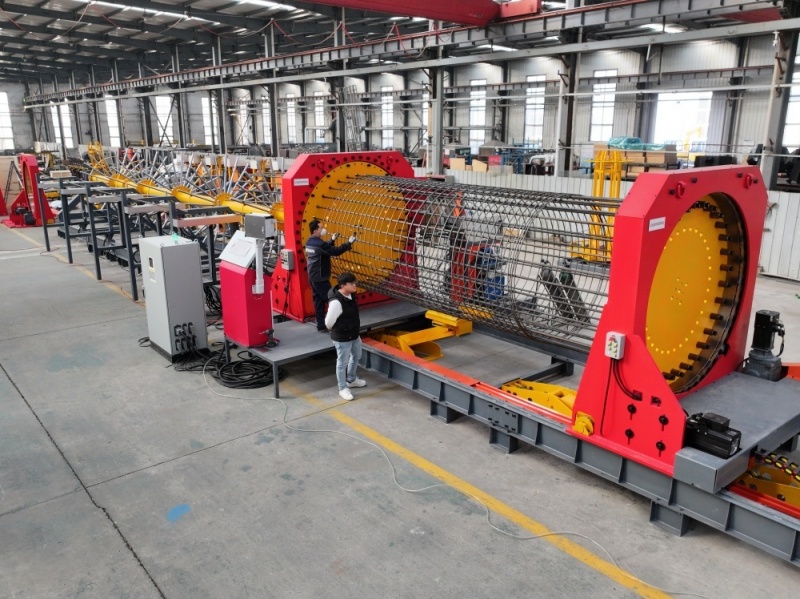
What is a Pile Cage Welding Machine?
An automatic reinforcement cage welding machine is a production system that fabricates cylindrical or square reinforcement cages automatically. The machine rotates the cage while longitudinal main bars and transverse spiral or ring bars are fed into position, then resistance-welds each intersection automatically through a CNC-controlled welding carriage. The operator only sets the cage diameter, bar spacing, and welding parameters on a touchscreen; the machine then completes the entire cage in a continuous cycle. Compared with manual tying, automatic welding produces stronger joints, uniform spacing, and consistent diameters, with productivity several times higher per shift.
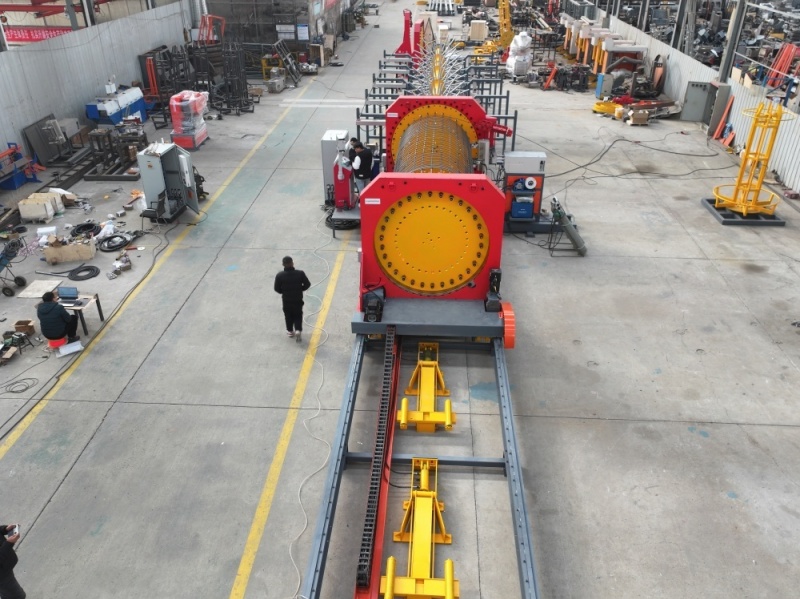
At its core, the automatic reinforcement cage welding machine consists of several coordinated subsystems: a heavy-duty frame with a rotating disc that carries the cage, a feeding system that positions longitudinal bars and transverse rings, a CNC control cabinet that stores production recipes, and a welding carriage that travels along the cage to weld each intersection. Because every subsystem is programmable, the same machine can produce cages for different pile diameters and bar layouts simply by loading a new recipe. This flexibility is what makes the equipment valuable not only for large pile plants but also for contractors that handle a changing mix of projects throughout the year.
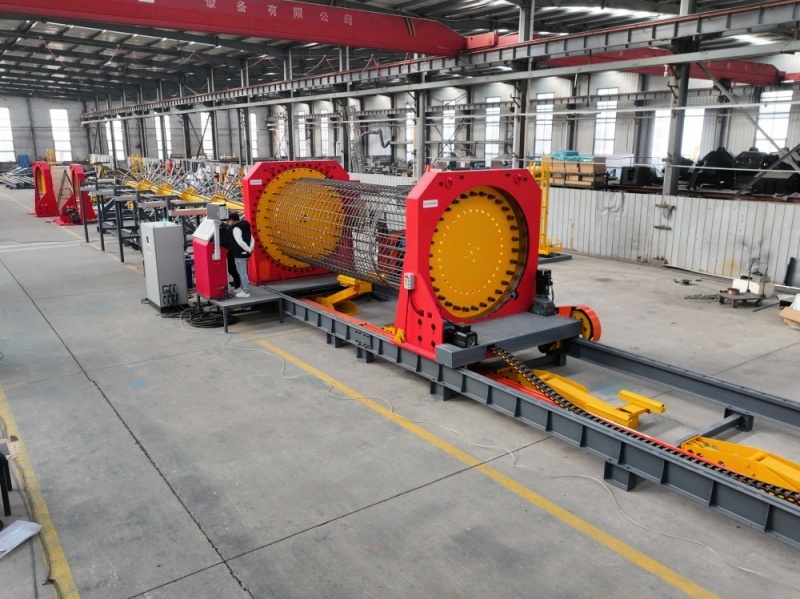
How Does It Work?
The operating principle of the automatic reinforcement cage welding machine is straightforward: the machine rotates the cage body while the welding system moves along its length. Longitudinal main bars are first clamped around the rotating disc at the correct diameter, and transverse ring bars or spirals are fed at programmed intervals. As the cage rotates, the welding carriage travels forward, applying resistance welding at every point where a ring bar crosses a main bar. The CNC system synchronizes rotation speed, carriage travel, and welding current, so joints are uniform even on long cages.
The process begins with data entry: the operator selects or creates a recipe containing the cage diameter, ring spacing, rotation speed, and welding parameters. Bars and rings are then loaded onto the machine, either manually or through automatic feeding devices. Once started, the machine completes the cage in a continuous cycle and stops automatically at the finished length. The finished cage is lifted off the machine and moved to the storage area or directly to the pile position, and the machine is ready for the next cage.
Step-by-Step Production Process
· Prepare materials: cut main bars to length and feed rings into the machine's ring magazine; verify bar diameters match the recipe.
· Set up the machine: select the cage recipe on the touchscreen and load the longitudinal main bars around the rotating disc.
· Start automatic feeding: the ring feeding device positions transverse rings at the programmed spacing as rotation begins.
· Automatic welding: the CNC-controlled carriage welds every intersection with regulated current and pressure while traveling along the cage.
· Complete and unload: the machine stops at the finished length; the cage is lifted off, inspected, and moved to storage or the pile position.
Key Factors to Consider
· Production capacity: evaluate cages per day and whether the machine can keep up with your piling schedule.
· Diameter range: confirm the machine covers the smallest and largest cage diameters used on your projects.
· Weld quality control: check that the welding current, pressure, and travel speed are automatically regulated for consistent joints.
· Automation level: decide between semi-automatic and fully automatic feeding of rings and main bars.
· After-sales support: choose a manufacturer with fast spare parts delivery, remote diagnostics, and on-site commissioning.
Types of Machines
· Semi-automatic cage welders: ring feeding is partially manual; suitable for small workshops with mixed production.
· Fully automatic cage welding machines: ring and main bar feeding are automated, ideal for high-volume pile plants.
· CNC-controlled cage welding systems: programmable parameters for multiple cage specifications with one-button changeover.
· Square cage welding machines: purpose-built for rectangular cages used in diaphragm walls and special foundations.
Applications
· Bored pile and drilled shaft foundations for bridges, piers, and marine structures.
· High-rise building foundations and deep basement works requiring large-diameter cages.
· Infrastructure projects including highways, railways, ports, and power plants.
· Precast concrete production where steady, repeatable cage supply keeps casting lines running.
Common Mistakes
· Buying based on price alone without comparing welding speed, accuracy, and energy consumption.
· Ignoring the maximum rebar diameter the machine can handle, then discovering it cannot weld your main bars.
· Choosing a machine without touchscreen programming, making parameter changes slow and error-prone.
· Overlooking spare part availability, leading to long downtime when electrodes or bearings need replacement.
· Failing to train operators, which wastes the machine's potential and increases the risk of errors.
Recommended Solutions
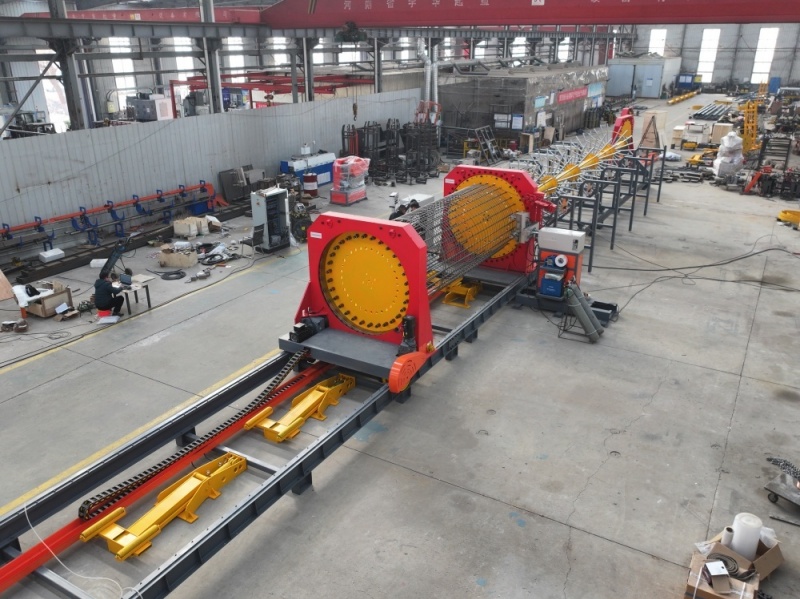
Luyuan Machinery offers a complete range of automatic reinforcement cage welding machines covering cage diameters from 300 mm to 2500 mm. Our CNC control system stores dozens of recipes, the variable-frequency rotating disc delivers smooth speed control from 0 to 20 RPM, and the multi-function fixed ring feeding device positions transverse rings automatically, cutting cycle time by up to 40 percent. Every machine is tested in our factory before shipment, and our engineers provide installation guidance and operator training on site. For international buyers, we supply documentation, spare parts kits, and remote technical support.
Frequently Asked Questions
Q: How much faster is an automatic cage welding machine than manual tying?
A: Depending on the configuration, an automatic machine typically produces 3 to 5 times more cages per shift than a manual team, with more consistent weld quality.
Q: What cage diameters can Luyuan machines produce?
A: Our standard range covers 300 mm to 2500 mm diameter cages, and custom machines can be built for larger or special geometries.
Q: Does the machine require special training to operate?
A: No. The 7-inch touchscreen guides the operator through setup, and our engineers provide on-site training so your team is productive within days.
Q: Can the machine weld different rebar grades?
A: Yes. Welding parameters are adjustable and pre-set recipes cover common rebar grades used in international construction.
Q: What maintenance does an automatic cage welding machine need?
A: Routine maintenance covers electrode replacement, lubrication of drives and bearings, hydraulic oil checks where applicable, and periodic calibration of sensors. Our manual provides a clear schedule, and spare parts kits cover the first two years.
Q: How long does it take to produce one cage?
A: Cycle time depends on cage diameter, length, and ring spacing; typical cages are completed in 20 to 45 minutes, which is several times faster than manual tying for the same cage.
Conclusion
Automatic reinforcement cage welding machines have become standard equipment for contractors who want to scale foundation work profitably. By choosing a proven manufacturer with local support, you get higher output, better weld quality, and a rapid return on investment. Luyuan Machinery is ready to help you select the right system for your projects.
Whichever angle you evaluate, the conclusion is consistent: automated cage welding delivers measurable gains in output, quality, and operating cost compared with manual methods. The key is to match the machine to your real production profile and to work with a supplier that stays with you after delivery. Luyuan Machinery has the product range and the support structure to make that possible, and our engineers are available to discuss your specific cage production requirements at any time.


