How Does a Pile Cage Welding Machine Improve Efficiency in Large Piling Projects?
2026/08/19 15:02

A Bridge Foundation Project in Malaysia Shows Why Contractors Move to Automatic Cage Production

In Johor, Malaysia, a piling contractor faced a common problem during a highway expansion project. The project required hundreds of reinforcement cages with a diameter of 1500mm, but the existing manual fabrication method could not maintain the required production schedule.

The workshop had enough workers, but cage production speed was still limited. Spiral spacing varied between different workers, and several cages needed adjustment before installation.

After installing a pile cage welding machine, the contractor changed the production process. The machine handled spiral wire feeding, cage rotation, and welding points automatically. During continuous production, the spiral pitch tolerance was controlled within ±5mm, which reduced correction work before cages were transported to the construction site.

This type of situation is why more piling companies are looking at automatic cage production equipment. When a project requires hundreds of piles, controlling production consistency becomes as important as production speed.

What Is a Pile Cage Welding Machine?

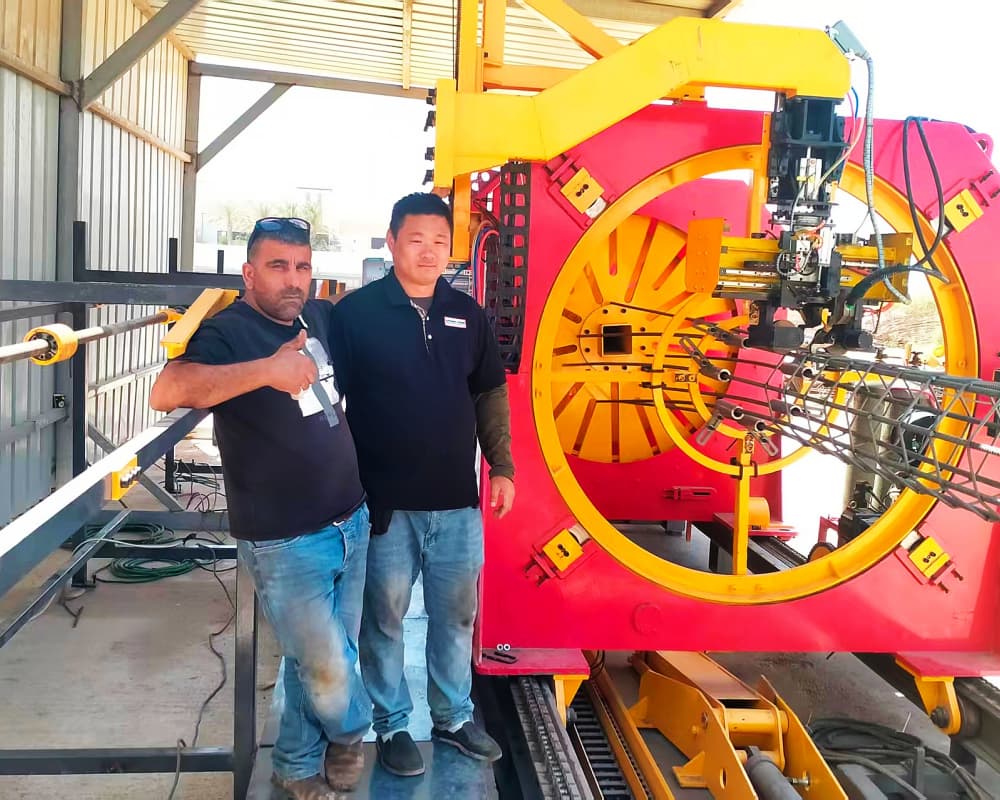
Pile Cage Welding Machine

A pile cage welding machine is an automated system used to manufacture reinforcement cages for bored piles, bridge foundations, and other concrete structures.

The machine works by fixing longitudinal steel bars onto a rotating frame. A spiral reinforcement wire is fed around the cage while the frame rotates at a controlled speed. Welding electrodes connect the spiral wire and main bars at programmed intervals.

The process replaces repeated manual tying work.

For a typical foundation project, the customer may need cages with different diameters, lengths, and reinforcement specifications. A properly configured machine allows operators to adjust these parameters through the control system instead of rebuilding the production setup each time.

For example, producing a 1200mm diameter cage with 12 pieces of 16mm main bars and a 10mm spiral wire requires accurate control of rotation speed and welding current. Depending on steel grade and configuration, welding current normally works around 180-220A.

The machine does not make engineering decisions. The drawings still come from the project engineer. What it does is repeat the manufacturing process accurately once those requirements are confirmed.

Why Contractors Replace Manual Cage Fabrication

Manual cage fabrication remains practical for some projects.

Honestly, for one-off small piles, manual tying may still make sense. A contractor building a small number of foundations may not need automated production.

Large piling projects are different.

When a contractor needs 300, 500, or 1000 cages, production management becomes harder. Labor availability, cage dimensions, and delivery timing all affect the construction schedule.

A pile cage welding machine allows the workshop to produce cages according to fixed parameters. The operator sets:

  • Cage diameter

  • Cage length

  • Spiral pitch

  • Production speed

The equipment then follows the programmed process.

We have seen this difference in overseas projects. In one Southeast Asian piling workshop, the customer produced 20-meter-long cages for bridge foundations. Before automation, workers had to manually check spiral spacing several times during fabrication. After installing the machine, the production team reduced manual measurement work and improved daily output stability.

The result was not simply faster welding. It was easier production planning.

How Does a Pile Cage Welding Machine Work?

The operation process is based on several coordinated movements.

The longitudinal bars are placed on the main frame according to the required cage diameter. The rotating system keeps the cage moving while the spiral wire feeding device controls the spacing between each spiral turn.

When the spiral wire reaches the welding position, the welding system creates a connection between the spiral and longitudinal bars.

The main working steps include:

  • Loading longitudinal reinforcement bars

  • Setting production parameters

  • Automatic spiral wire feeding

  • Welding during cage rotation

The machine configuration depends heavily on project requirements.

A small foundation contractor may need equipment for cages between 500mm and 1000mm diameter. A bridge or port construction company may require a larger system handling cages above 2500mm.

The length of the cage also affects machine design. A 6-meter cage and a 24-meter cage require different supporting structures to maintain straightness during production.

Key Factors When Choosing a Pile Cage Welding Machine

Many buyers focus on machine appearance when comparing suppliers. In practice, several technical details decide whether the equipment fits the project.

Cage diameter range is one of the first questions.

A machine designed for medium-sized foundation cages may not be suitable for heavy bridge piles using large diameter reinforcement bars.

Steel specifications also matter. Projects using 32mm or 40mm main bars require stronger mechanical structures and suitable welding capacity.

Before manufacturing, Luyuan Machinery normally confirms:

  • Required cage diameter

  • Main bar quantity and diameter

  • Spiral wire size

  • Target daily production

Electrical conditions are also checked before shipment. Customers in different countries may use different voltage standards, so the machine configuration needs to match local requirements.

A correct specification saves time during installation.

Applications of Pile Cage Welding Machine

Pile Cage Welding Machine

Bridge Construction

Bridge foundations often require large numbers of reinforcement cages with consistent dimensions. Automatic production helps contractors prepare cages according to construction schedules.

High-Rise Buildings

Urban construction sites usually have limited working areas. Compact machine designs allow contractors to produce cages closer to the project location.

Railway and Infrastructure Projects

Long-term infrastructure projects require stable reinforcement cage production because installation accuracy affects later concrete work.

Rebar Processing Factories

Some steel processing companies use the equipment to produce finished cages for local contractors and construction companies.


How Luyuan Machinery Builds Pile Cage Welding Solutions for Global Customers
luyuan machinery

Different construction companies have different production conditions.

A contractor working on bridge foundations may need continuous production for large diameter cages. A local rebar processing factory may need flexible production because it serves multiple construction companies with different requirements.

Luyuan Machinery does not recommend the same machine configuration for every customer.

Before production, our engineering team reviews cage drawings, steel bar specifications, production targets, and workshop conditions. The purpose is simple: make sure the equipment matches the actual working environment.

For example, one customer from Egypt had limited workshop space but needed automatic cage production. Instead of supplying a standard machine layout, we adjusted the equipment structure to reduce the installation area while keeping the required cage diameter range.

Another customer in Vietnam required equipment for long reinforcement cages used in infrastructure projects. The machine configuration was adjusted according to their cage length and local power conditions.

Small details decide whether a machine works well after installation.

Factory Testing Before Shipment

A machine should be tested before it reaches the customer site.

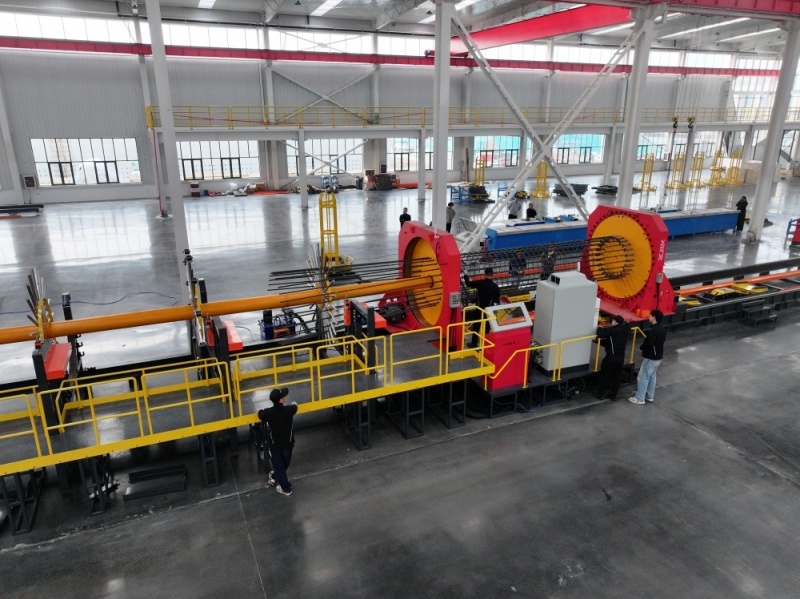
At Luyuan Machinery, each pile cage welding machine goes through factory testing before shipment.

The testing process includes:

  • Rotation system inspection

  • Welding operation test

  • Control system checking

  • Trial cage production

During testing, the machine runs with customer production parameters whenever possible. This helps confirm that cage diameter, spiral spacing, and welding operation meet the project requirements.

For overseas customers, installation preparation is also important. We provide operation instructions, technical communication, and spare parts support to help customers start production smoothly.

A machine is only useful when it can keep producing after installation.

Common Questions About Pile Cage Welding Machine

1. What size reinforcement cages can a pile cage welding machine produce?

The cage diameter depends on the machine model and project requirements.

Common configurations can produce cages from several hundred millimeters to more than 3000mm diameter. Customers should provide their cage drawings before selecting the equipment.

2. How much production capacity can a pile cage welding machine achieve?

Production capacity depends on cage diameter, cage length, steel specifications, and machine configuration.

For example, a medium-size cage production line may reach around 20-35 meters per hour under normal working conditions. Heavy cages with larger diameters usually require different production settings.

3. How many operators are needed?

Most customers operate the machine with one trained operator.

Additional workers may be needed for steel bar loading, cage movement, and workshop handling depending on production volume.

4. Can one machine produce different cage diameters?

Yes.

Many models allow diameter adjustment within a certain range. The actual adjustment range depends on machine design and customer requirements.

5. What information should be provided before quotation?

Before recommending a machine, customers should provide:

  • Cage diameter range

  • Cage length

  • Main bar diameter and quantity

  • Spiral wire diameter

  • Expected daily production

With these details, the engineering team can recommend a suitable configuration.

Contact Luyuan Machinery for Your Piling Project

Choosing a pile cage welding machine is not only about purchasing equipment. It is about matching the machine with your production requirements, steel specifications, and construction schedule.

If you are planning a piling project or operating a reinforcement processing factory, send your cage diameter, bar grade, and target daily output to:

sales@shandongluyuan.com

Luyuan Machinery will review your requirements and provide a suitable machine specification for your project.


Related Products

x