
Reinforcement Cage Welding Machine Improve Piling Project Efficiency
A Highway Foundation Project in Indonesia Shows the Value of Automatic Cage Production
A foundation contractor in Indonesia faced a production problem during a highway expansion project. The project required more than 800 reinforcement cages, with cage diameters ranging from 1200mm to 1800mm. The original workshop relied on manual steel fixing, and each cage required several workers to complete spiral reinforcement installation.
The problem appeared when the construction schedule became tighter.
The contractor could prepare enough steel materials, but daily cage output was limited by labor availability. Workers also needed extra time to check spiral spacing because different teams produced slightly different results.
After installing a reinforcement cage welding machine, the production process became easier to control. One trained operator could manage cage rotation, spiral wire feeding, and welding parameters through the control panel. The workshop reduced repeated manual work and maintained more consistent cage dimensions.
In cages we shipped to a piling site in Johor, Malaysia, spiral pitch tolerance stayed within ±5mm during continuous production. For contractors working on large foundation projects, this type of consistency affects transportation, installation, and construction planning.
What Is a Reinforcement Cage Welding Machine?
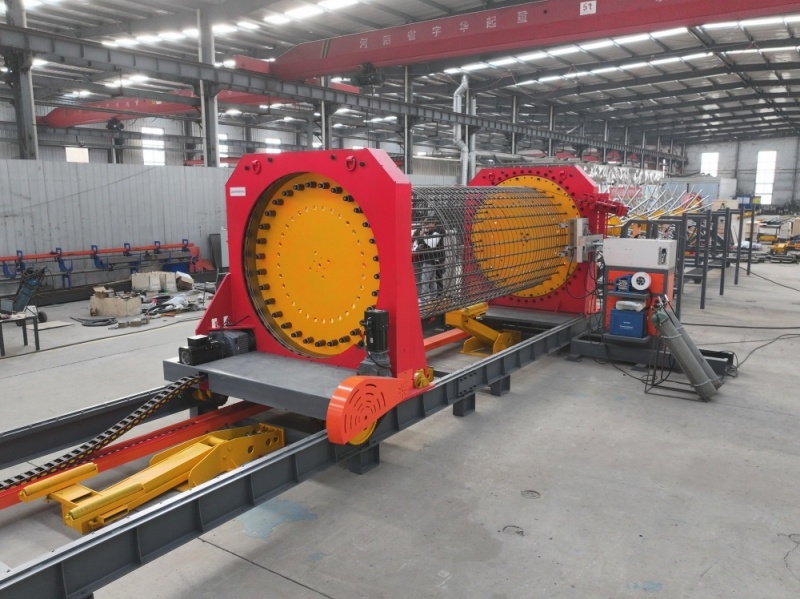
A reinforcement cage welding machine is an automated production system used to manufacture steel reinforcement cages for bored piles, bridges, buildings, and infrastructure projects.
The equipment connects longitudinal reinforcement bars with spiral wires through automatic feeding, rotation control, and welding operations.
Traditional cage fabrication depends heavily on manual labor. Workers need to position steel bars, wrap spiral wires, measure spacing, and fix connections one by one. This method can work for small projects, but production management becomes difficult when hundreds of cages are required.
A reinforcement cage welding machine follows programmed parameters.
Operators can set:
Cage diameter
Cage length
Spiral spacing
Welding requirements
After setup, the machine repeats the same production process for each cage.
For example, when producing a 1200mm diameter cage with 12 pieces of 16mm main bars and a 10mm spiral wire, the welding parameters must match the steel specification. Under normal production conditions, welding current is usually controlled around 180-220A depending on material grade and machine configuration.
The equipment does not decide the cage design. Engineering drawings still determine the reinforcement structure. The machine helps transform those drawings into repeatable production.
How Does a Reinforcement Cage Welding Machine Work?
The working process is based on coordinated mechanical movements.
The operator places longitudinal steel bars onto the supporting frame according to the required cage diameter. The rotation system turns the cage at a controlled speed while the spiral wire feeding unit moves along the cage length.
When the spiral wire reaches the welding position, the welding system connects it with the main bars.
The production process includes:
Loading main reinforcement bars
Setting production parameters
Automatic spiral wire feeding
Welding during cage rotation
The operator mainly monitors the machine and checks the finished cage.
This changes the role of workers in the workshop. Instead of several people manually tying every connection, one trained operator can control the automatic process while other workers focus on material preparation and handling.
For a construction company producing 500 or 1000 cages, this difference changes daily production planning.
Why Contractors Choose Automatic Cage Welding Equipment
Manual cage fabrication is still useful in certain situations.
Honestly, for one-off small piles, manual tying may still make sense. The production volume may not justify automated equipment.
Large piling projects are different.
A bridge foundation project may require hundreds of cages with the same diameter and reinforcement specifications. A high-rise building project may need continuous cage supply to avoid delays in concrete pouring schedules.
A reinforcement cage welding machine helps contractors reduce dependence on manual operations.
The main changes are:
Fewer workers involved in repeated cage fabrication
More stable production output
A Southeast Asian customer producing 18-meter-long bridge foundation cages previously needed several workers to measure spiral spacing manually. After using automatic equipment, the team reduced measurement work and improved production organization.
The machine does not remove the need for skilled workers.
It moves workers from repetitive tasks to production supervision.
Technical Factors When Selecting a Reinforcement Cage Welding Machine
Many buyers compare machines by appearance or production capacity only. In practice, the correct configuration depends on the project details.
Cage diameter is one of the first factors to confirm.
A machine designed for 600-1200mm diameter cages may not be suitable for large bridge piles requiring cages above 2500mm.
Steel bar specifications also affect equipment selection.
A cage using 12mm or 16mm main bars has different requirements compared with heavy foundation cages using 32mm or 40mm reinforcement bars.
Before recommending a machine, Luyuan Machinery usually confirms:
Required cage diameter range
Main bar quantity and size
Spiral wire diameter
Target daily production
Cage length also affects machine structure.
A 6-meter building foundation cage and a 24-meter bridge foundation cage require different supporting systems to maintain straightness during production.
Workshop conditions should also be considered. Some customers have large production areas, while others need compact layouts because of limited factory space.
Applications of Reinforcement Cage Welding Machine
Bridge and Highway Foundations
Large infrastructure projects require many reinforcement cages with consistent dimensions. Automatic production helps contractors prepare cages according to construction schedules.
High-Rise Building Foundations
Urban projects often have limited working space. Compact equipment layouts allow cage production closer to the construction area.
Rebar Processing Factories
Some steel processing companies purchase equipment to produce finished reinforcement cages for local contractors.
Railway and Tunnel Projects
Long-term infrastructure construction requires stable cage production because reinforcement accuracy affects installation quality.
Luyuan Machinery Provides Customized Cage Production Solutions
Every project has different production requirements.
A bridge contractor may need equipment for large diameter cages and long production cycles. A local steel processing factory may need flexible adjustment because it serves different construction customers.
Luyuan Machinery reviews project information before recommending equipment.
The engineering team checks:
Construction drawings
Cage specifications
Production target
Workshop conditions
For example, an Egyptian customer needed a reinforcement cage welding machine but had limited workshop space. The equipment layout was adjusted to fit the customer's factory while keeping the required cage production range.
Another customer from Vietnam required long cages for infrastructure construction. The machine configuration was adjusted according to cage length and local power conditions.
The correct equipment is not always the biggest machine.
It is the machine that matches the customer's production requirements.
Factory Testing Before Shipment
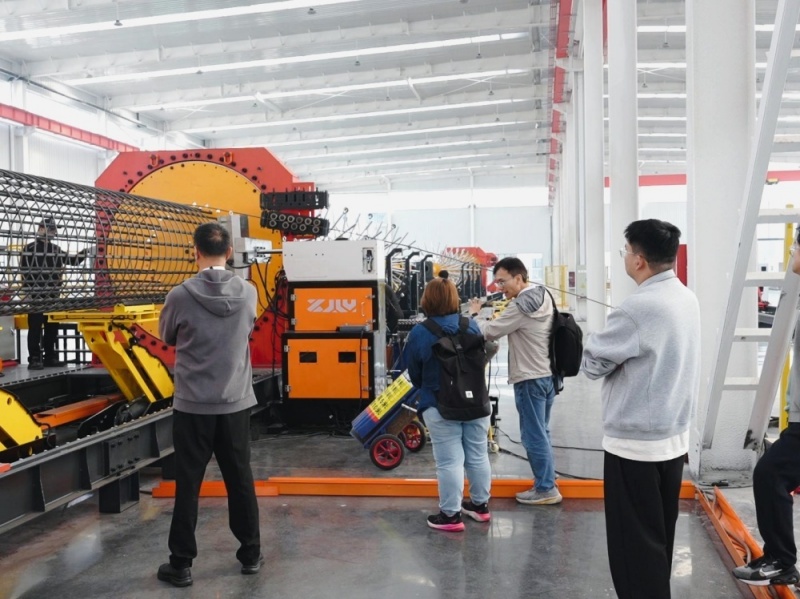
Before delivery, every reinforcement cage welding machine is tested in the Luyuan Machinery factory.
Testing includes:
Rotation system inspection
Welding operation test
Control system checking
Trial cage production
Whenever possible, testing is performed according to customer requirements.
For example, if a customer requires a 1500mm diameter cage with specific spiral spacing, the machine parameters can be adjusted and checked before shipment.
Luyuan Machinery provides technical documents, installation guidance, and spare parts support for overseas customers.
For product details and project consultation, contact:sales@shandongluyuan.com


