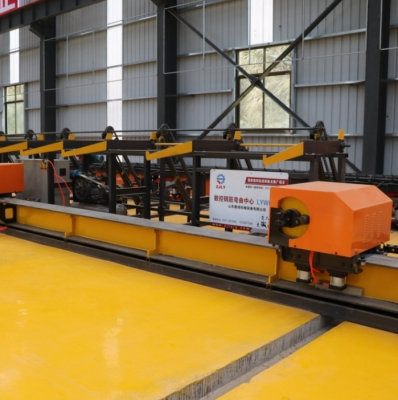
What Is a Rebar Bending Machine?
A rebar bending machine turns straight reinforcing bar into the shapes a bar bending schedule calls for: stirrups, hooks, U-bars, L-bars, Z-bars and multi-leg links. It feeds the bar, measures the length, then rotates a bending table or head around a mandrel until the programmed angle is reached. No heating, no hammer, no guesswork. For contractors, fabricators and procurement engineers comparing quotations, the useful question is not only what a rebar bending machine is, but which type and capacity fit the work you actually bid for.
Why the Definition Matters to Overseas Buyers
Reinforcement work has moved out of the trench and into the fabrication yard. Bored pile cages, precast segments and bridge panels are now assembled from pre-bent bars, inspected before delivery and lifted into place as finished units. That changes what buyers expect: a machine no longer has to produce one serviceable 90-degree hook, it has to repeat a schedule of hundreds of position marks to within a few millimetres, with fewer skilled operators.
The terminology also causes confusion in quotations. "Rebar bender", "steel bar bender", "stirrup bender" and "bending center" are used almost interchangeably, yet they describe machines with very different capabilities and price levels. Comparing a pin-and-disc bender against a CNC center on price alone usually leads to the wrong purchase.
Three Families of Bending Equipment
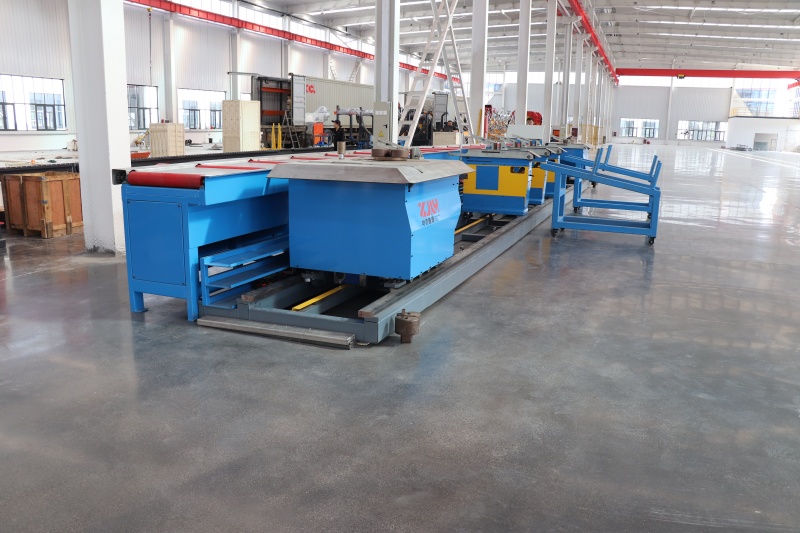
Mechanical and manual benders. A flat table with a rotating disc, a centre pin and bend pins. The operator positions the bar against a stop and the disc rotates to a preset angle. Inexpensive and robust in dusty yards, they remain the right answer for low volumes, site work and very large diameters. The limit is labour: every position mark is handled individually.
Semi-automatic benders. Powered feeding, an adjustable stop and often a hydraulic head. Output rises, but changeover between shapes still needs manual adjustment.
CNC bending machines and bending centers. The bar is fed, straightened, measured by encoder, bent by servo-driven tooling and cut in one continuous cycle. Programs store the geometry of each position mark, so changeover means selecting the next program. Some models carry two bending heads and form closed stirrups or double-direction bends in a single pass.
How the Bending Cycle Works
On an automatic rebar bending machine the cycle is fixed. The bar enters a straightening unit with staggered rollers that remove coil curvature. A servo feed advances it a programmed distance measured by encoder. At the target length the bending head rotates around a mandrel while a clamping die holds the bar, then either returns to zero for the next bend or bends from the opposite direction so a closed shape can be completed in one pass. A shear cuts the bar and the finished piece drops into a collecting table.
Two details separate a machine that holds tolerance from one that drifts. The first is springback compensation: steel does not stay at the angle the tooling imposes, so the controller must over-bend by a value that depends on diameter, grade and mandrel ratio. The second is tooling geometry. Design codes such as ACI 318, EN 1992 and BS 8666 set minimum mandrel diameters relative to bar size, so the wrong tooling set will either crack the bar or fail inspection.
Specifications That Decide Fit
Maximum bar diameter is the headline number on most datasheets and the least informative on its own. Read it together with the following.
Diameter at grade. A machine rated 32 mm at 400 MPa may only handle 25 mm at 500 MPa.
Angle range. Standard shapes need 0-180 degrees; seismic hooks and closed links need more, plus repeatable multi-angle sequences.
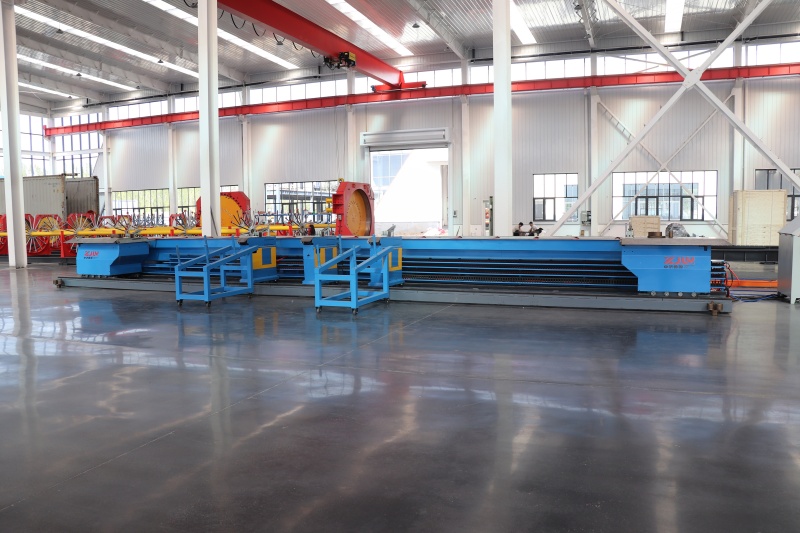
Table and infeed length. Long U-bars and bridge links need support along their full length, which affects accuracy and safety.
Guaranteed tolerance. Ask for the length and angle tolerance in writing and check it against your schedule.
Control system. Program memory, number of stored schedules, data import, and whether a fitter can operate it without programming training.
Power supply. Export machines must match site voltage and frequency: 380 V/50 Hz, 415 V/50 Hz or 440 V/60 Hz.
Tooling and spares. Mandrels, pins, shear blades and clamping dies wear; confirm a spares route before ordering.
Where These Machines Earn Their Cost
In pile foundation work, bending equipment forms the spiral, link rings and closing hoops that hold a cage together before welding. Ring diameter controls cover, so repeatability across a hundred cages matters more than single-bend speed.
On bridges, pier caps and deck slabs use dense reinforcement with many short multi-leg links, slow to produce by hand and exactly where automatic bending pays back.
In high-speed rail and precast yards, geometry repeats across thousands of identical units, so program-based bending removes setup time from the critical path.
In rebar processing plants, the bending department is usually the constraint between cutting and assembly, and adding automatic capacity is often the cheapest way to lift throughput.
Selecting a Configuration
LUYUAN builds bending equipment for exactly this range of work. The rebar bending center targets fabricators and processing plants that need to convert a schedule into finished shapes with minimal manual handling: servo-controlled feeding and bending, program storage for repeated position marks, and tooling covering the common stirrup and link diameters. It suits buyers running a mixed schedule rather than a single shape, and who value changeover time and repeatability over raw single-bend speed.
Configuration should follow the schedule, not the brochure. Start with the largest diameter and highest grade in the project, then the longest single piece, then the number of distinct position marks per shift.
FAQ
What is the difference between a rebar bender and a rebar cutter?
A bender changes the shape of the bar; a cutter divides it to length. Combined machines are common, but the two capacity ratings are separate and should be checked independently.
Can a rebar bending machine produce closed stirrups?
Yes, if the machine and tooling are specified for it. Closed links and seismic hoops need a double-bending head or a two-stage sequence with correct mandrel geometry. Confirm the shape against your own schedule before delivery.
How accurate is an automatic machine?
Length accuracy is encoder-controlled and angle accuracy comes from servo position plus springback compensation. Figures vary by manufacturer and bar size, so request a written tolerance and a witnessed test on your bar grade.
What diameters can these machines handle?
Manual tables commonly cover 6-32 mm; automatic centers are usually offered up to 32 mm or 40 mm at 400-500 MPa.
Manual bender or CNC?
Count position marks and pieces per shift. Manual equipment is economical for low volume and site work. Once a yard repeats the same shapes in the hundreds, labour and inspection cost usually exceed the price difference within a project or two.
Next Step
Bending capacity, tooling range and control system decide whether a rebar bending machine earns its place in a yard, and none can be judged from a price list. Send LUYUAN your bar bending schedule, the maximum diameter and grade you work with, and the shapes you produce most often. The technical team will confirm the matching configuration, share parameters and tooling lists, and quote a machine built for your schedule.